
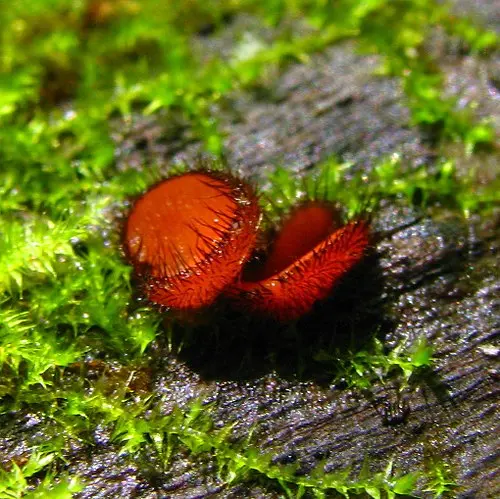
About this fungus
Eyelash Cup is a fungus in the Pyronemataceae family. Its habitat and field characteristics are summarised below.
A minute orange to deep red disc or shallow cup, usually found in damp groups on rotten wood or nearby wet ground. A fringe of stiff dark brown hairs around the rim gives the appearance of eyelashes when viewed closely.
What to check
Use a hand lens to confirm a shiny orange-red inner surface, a paler downy outer surface, no visible stem and long dark marginal hairs. Those features establish an eyelash-cup fungus, but not necessarily this exact species. Reliable separation within Scutellinia uses the length and rooted base of the hairs together with mature spore size and ornamentation under a microscope.
Variation
Young fruit bodies are more distinctly cup-shaped and nearly circular. They become shallow or almost flat with age and may develop uneven margins where neighbouring cups press together. The fertile surface ranges from bright orange through scarlet to deep red, while size varies from about 1 mm to 10 mm in many European accounts and occasionally reaches 15 mm in North American accounts.
Lookalikes
Many Scutellinia species share the same red disc and dark eyelash fringe, and field photographs are often best recorded as Scutellinia species until microscopy is available. Scutellinia setosa is smaller and generally duller, while other regional species differ mainly in their hairs and spores. Cheilymenia species can also be small and hairy but often have paler hairs. Scarlet Elfcups in Sarcoscypha are much larger, deeper cups with no dark eyelash fringe.
Habitat and range
A saprotrophic fungus of consistently damp, decaying material. It is reported from long-rotted wood, wet humus-rich soil, leaf litter and other decomposed vegetation, with occasional records from dung or old fungal fruit bodies. Published accounts cover Europe, North America, Asia, South America and Australasia, but local microscopy remains important because similar Scutellinia species occur worldwide.
Food safety
Inedible.
Photographs
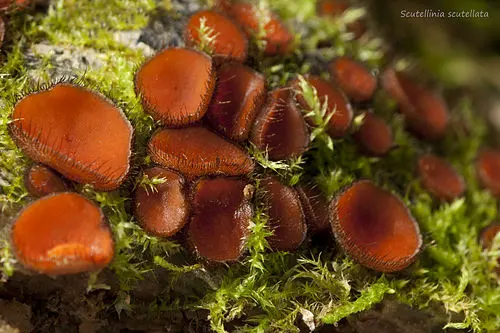 Rick Watts / CC BY-SA 3.0