
About this fungus
Fairy Ring Marasmius is a fungus in the Marasmiaceae family. Its habitat and field characteristics are summarised below.
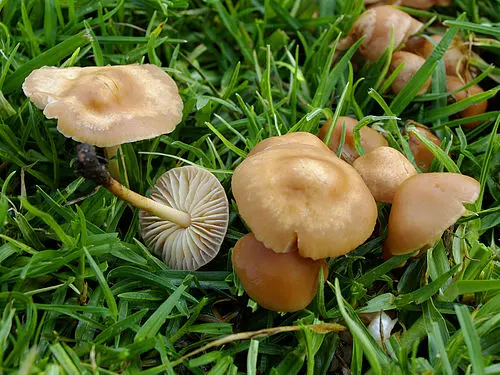
A small buff to tan grassland mushroom with a broad central hump, widely spaced pale gills and a thin but remarkably tough stem. It often fruits in arcs or rings, although other fungi can make the same pattern.
What to check
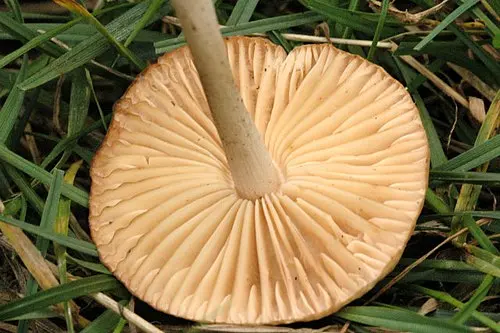
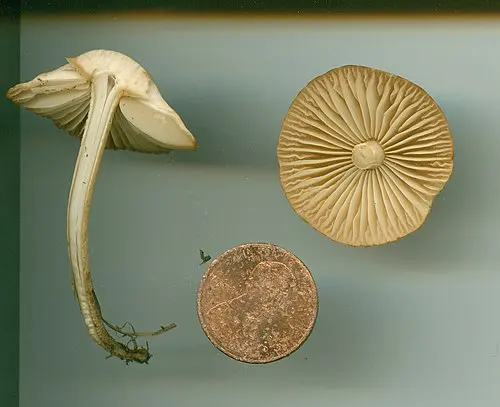
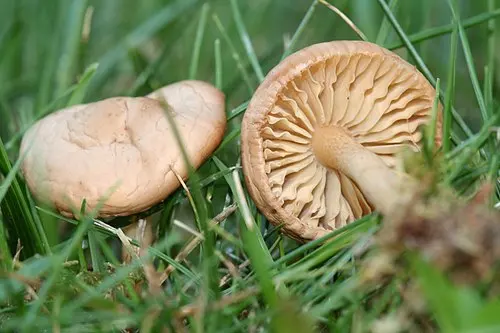
Check for a dry smooth cap about 2 to 6 cm across with a broad central umbo, broad well-spaced whitish to cream gills, a tough fibrous ringless stem, and a white spore print. Confirm these features on each mushroom because unrelated species can fruit within the same patch of grass.
Variation
The cap is hygrophanous, changing from tan, ochre or reddish-brown when moist to pale buff or cream as it dries. Dry mushrooms can shrivel and later revive after rain. Caps usually flatten with age while keeping a broad central hump.
Lookalikes
Clitocybe rivulosa and its close relatives can grow in the same short grass and also have a white spore print, so spore colour does not separate them. They usually have crowded, thinner gills that run down the stem and a pale cap without the same broad umbo. A fairy ring by itself is not an identification, and mixed collections from grass need particular care.
Habitat and range
A grassland saprotroph found in lawns, meadows, pasture, roadside grass and coastal dunes. Its underground colony expands outwards, producing arcs or rings that can return over many years.
Food safety
Choice edible.
Use this profile to learn what to examine and compare, not as proof that a mushroom is safe to eat. Check the whole specimen and every important lookalike before reaching an identification.
Photographs
 James Lindsey / CC BY-SA 3.0
 Stripey the crab / CC BY-SA 3.0
 Strobilomyces / CC BY-SA 3.0