
About this fungus
False Death-cap is a fungus in the Amanitaceae family. Its habitat and field characteristics are summarised below.
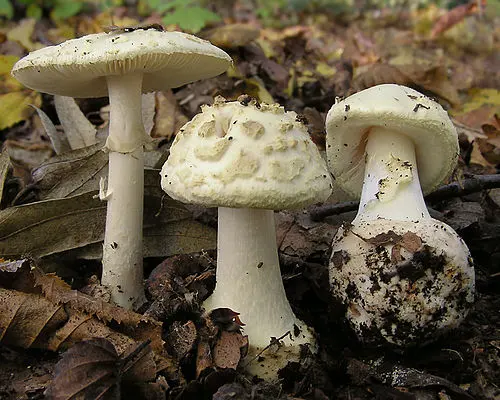
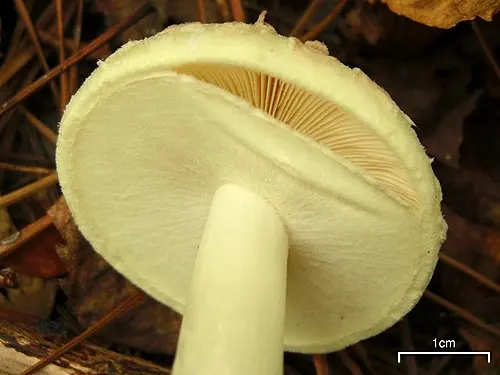
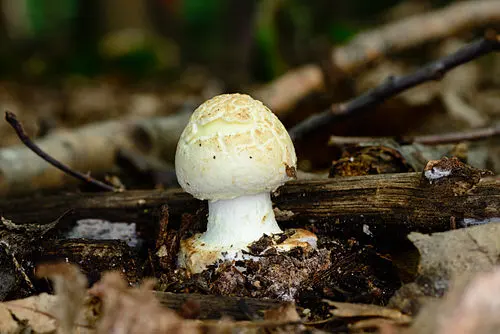
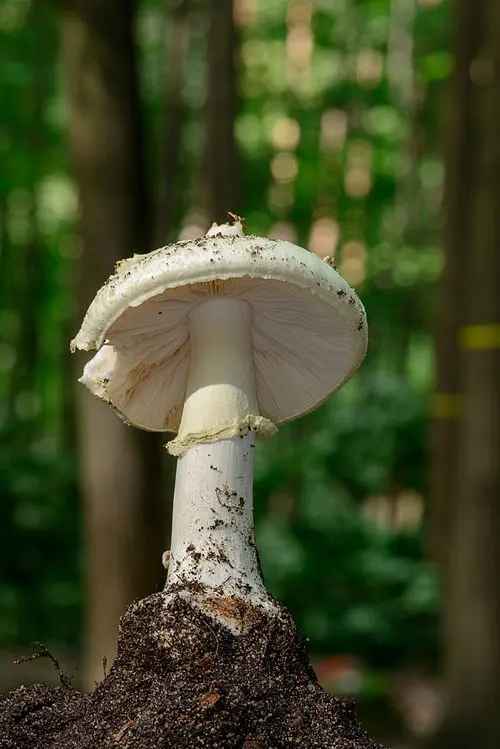
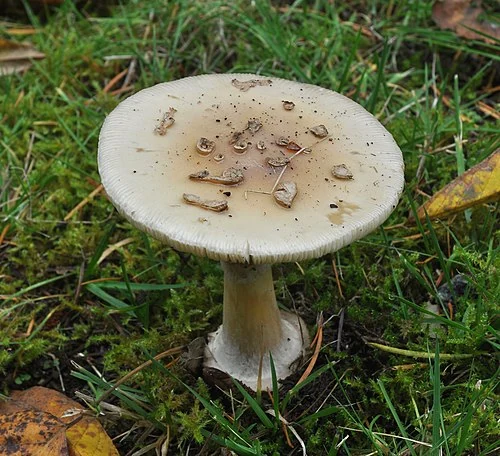
A pale lemon, ivory or white woodland Amanita with scattered white to yellowish veil patches on its cap. It has free white gills, a persistent ring and a broad basal bulb with a sharply margined, collar-like volva.
What to check
Examine the complete stem base rather than relying on cap colour. The bulb is broad and edged by a close-fitting gutter or collar, not the loose sack typical of Death Cap. Check for free white gills, an upper stem ring and cap patches, while allowing for rain to wash patches away. A raw-potato or radish-like smell can support the identification but may be faint or absent.
Variation
Typical caps are pale lemon or ivory, but var. alba is white. Veil patches vary from conspicuous to nearly absent after rain. Caps begin rounded, become convex and usually flatten, while the bulb and ring may be partly hidden by soil or damage.
Lookalikes
Death Cap, Amanita phalloides, has a loose sack-like volva and usually lacks persistent cap patches, but colour and veil remnants vary. Destroying Angel species are white and also have a sack-like volva. Amanita porphyria can share the margined bulb and potato-like smell but has a greyer to purplish-brown cap. No single field character safely separates every weathered specimen.
Habitat and range
Ectomycorrhizal on acidic or sandy soil with broad-leaved and coniferous trees, particularly oak, beech and pine. It is widespread across Europe and also recorded in parts of Asia and North America, fruiting mainly from summer through autumn.
Food safety
Edibility is uncertain or disputed.
Photographs
 Jason Hollinger / CC BY 2.0
 Norbert Nagel / CC BY-SA 3.0
 Norbert Nagel / CC BY-SA 3.0
 The High Fin Sperm Whale / CC BY-SA 3.0
Species to compare
Similar mushrooms to compare against: