

About this fungus
False Morel is a fungus in the Discinaceae family. Its habitat and field characteristics are summarised below.
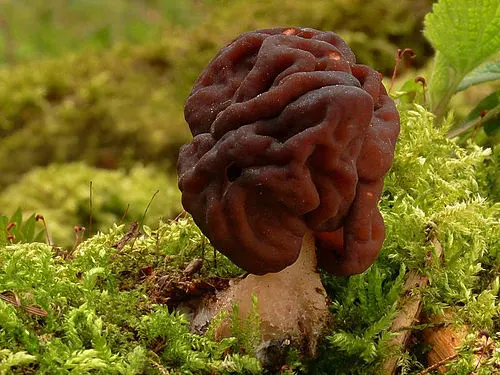
A spring fungus with an irregular red-brown cap folded into rounded, brain-like lobes above a short pale stem. The cap is often broader than it is tall and lacks the regular pits and ridges of a true morel. Its shape can range from a compact wrinkled ball to a sprawling group of lobes.
What to check
Look for rounded folds rather than a honeycomb of deep pits with narrow rims. Cut the whole fruit body lengthways to inspect its structure. False Morel has irregular chambers between the folded cap and stem, and the stem itself contains uneven hollows. A true morel is continuously hollow from cap to stem and has a more organised pitted surface. Use several features because the wider false-morel group is variable.
Variation
The cap ranges from yellow-brown and reddish-brown to dark chestnut or almost black. Its folds may be tight and compact or loose and irregular. The stem varies from cream to pinkish-tan and can be partly hidden by the cap. Several closely related lineages have historically been placed under this name, particularly in North America.
Lookalikes
True morels, Morchella species, have a recognisable network of pits and ridges rather than rounded brain-like folds, and a lengthwise section shows one continuous hollow interior. Other Gyromitra species may be saddle-shaped or differently lobed, but their toxin content cannot be judged from shape alone. The name False Morel is used for several unrelated morel-like fungi, so it is not a precise identification by itself.
Habitat and range
Usually found on the ground in conifer forest, especially with pine, often on sandy soil and disturbed or previously burnt ground. It can also occur in mixed woodland, orchards and montane sites. Fruiting is mainly in spring and early summer across Europe and northern parts of North America.
Food safety
Deadly poisonous. Gyromitrin is converted in the body to monomethylhydrazine and can cause delayed vomiting and diarrhoea followed by liver injury, destruction of red blood cells, seizures, coma, kidney injury and death. Toxin levels and individual susceptibility vary. Although False Morel has a food tradition in parts of northern and eastern Europe, processing leaves residues and releases a volatile toxin. Previous uneventful consumption does not establish that another meal will be safe.
Photographs
 Giftlorchel.jpg: Lebrac / CC BY-SA 3.0