
About this fungus
False Parasol is a fungus in the Agaricaceae family. Its habitat and field characteristics are summarised below.
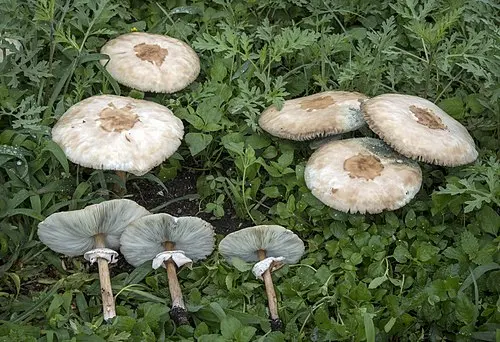
A large, sturdy lawn mushroom that resembles a classic parasol. Its pale cap breaks into tan, cinnamon or pinkish-brown scales as it expands, and a thick ring remains around the smooth stem. It often fruits in conspicuous groups, arcs or complete fairy rings. Mature specimens reveal the feature behind the name Green-spored Parasol: grey-green to brownish-green gills.
What to check
Use a mature specimen. The spore print should be a distinctive dull greyish-green, and crowded gills that began white should have become grey-green or brownish-green. Check that the gills are free or almost free from the stem, that a persistent thick ring is present, and that the stem is smooth or only finely textured rather than patterned like snakeskin. Take care with a young mushroom: its gills are white and it may be almost impossible to separate from a Shaggy Parasol by appearance alone. A mature white spore print points elsewhere, but a specimen that is too young or produces no print has not supplied a reliable answer.
Variation
Young caps may be almost spherical or egg-shaped and largely white, with a tan or brown central disc. They expand through convex to broadly flat, leaving scales that range from beige and cinnamon to pinkish-brown. The gills change much more than the cap, moving from white or yellowish through grey to green or greenish-brown as spores mature. Cut flesh is often unchanged but may turn pinkish-red or reddish-brown, especially near the stem base. The green colour can be dull rather than bright, and the species has no distinctive smell.
Lookalikes
Shaggy Parasol, Chlorophyllum rhacodes, can occupy the same lawns and disturbed ground. It has a white spore print and usually shows a stronger pinkish-orange to red cut-flesh reaction, but young specimens can be extremely difficult to separate. True Parasol, Macrolepiota procera, also has a white print and usually a slender stem covered in brown chevrons or snakeskin-like bands, plus a double ring that slides on the stem. In North America, Saproamanita thiersii can form lawn rings too, but remains white-gilled at maturity and has shaggy veil material on both cap and lower stem. Regional parasol groups are not equally well resolved, so mature gills and a spore print matter more than a familiar common name.
Habitat and range
Saprotrophic on dead organic matter in soil, especially in lawns, parks, meadows, playing fields, roadsides and other disturbed grassy places. It grows singly, in groups, in arcs or in fairy rings, usually during warm wet periods. It is common in warmer parts of North America and is also recorded across Central and South America, Europe, Asia, the Pacific and Australasia. Local fruiting months therefore vary with climate rather than following one universal season.
Food safety
Poisonous.
Photographs
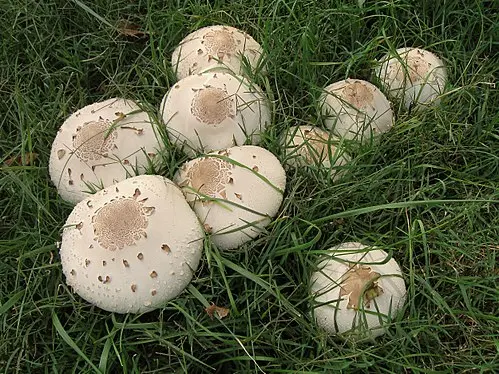 Brian Adamo / CC BY-SA 3.0
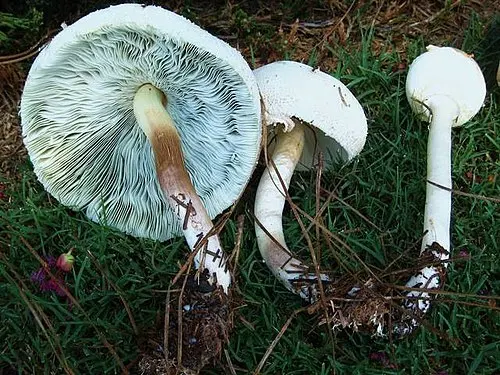 Amanita77 / CC BY-SA 3.0