

About this fungus
False Saffron Milkcap is a fungus in the Russulaceae family. Its habitat and field characteristics are summarised below.
A robust orange milkcap associated with spruce, often developing irregular green patches as it is bruised or ages.
What to check
Confirm crowded orange gills that run slightly down the stem and release orange latex when damaged. The latex becomes dark red to wine-red within about 10 to 30 minutes, then the damaged flesh and gills turn green. The orange stem is usually smooth rather than strongly pitted, with no ring or volva.
Variation
Caps range from bright orange to dull orange-brown and may be faintly zoned or nearly plain. Green staining becomes much more extensive in old or handled specimens.
Lookalikes
Saffron Milkcap, Lactarius deliciosus, is linked to pine and usually has a more clearly pitted stem. Lactarius fennoscandicus and other orange-latex milkcaps can require microscopic or DNA evidence. North American orange milkcaps represent different regional species, so this Eurasian name should not be assigned from appearance alone.
Habitat and range
Ectomycorrhizal mainly with spruce in acidic conifer woodland across Europe and parts of Asia. Tree association is an important part of the identification.
Food safety
Edible.
Use this profile to learn what to examine and compare, not as proof that a mushroom is safe to eat. Check the whole specimen and every important lookalike before reaching an identification.
Photographs
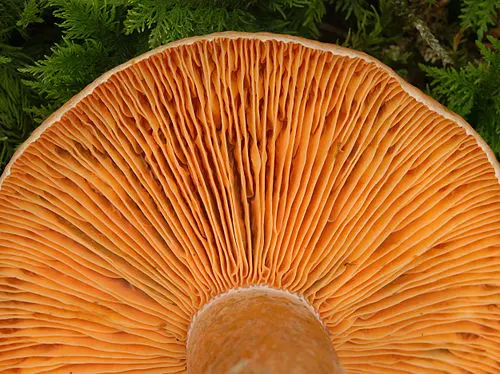 Andreas Kunze / CC BY-SA 3.0
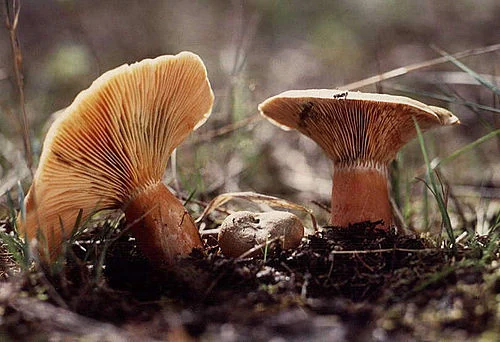 Wikimedia Commons / CC BY-SA 3.0
Species to compare
Similar mushrooms to compare against: