
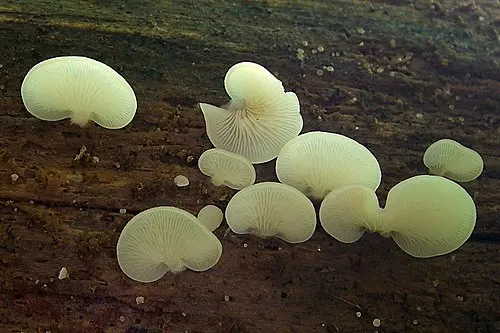
About this fungus
Flat Oysterling is a fungus in the Crepidotaceae family. Its habitat and field characteristics are summarised below.
A small, thin, white to cream oysterling that forms flattened fans or shells directly on dead broadleaved wood. A central stem is absent, and the gills radiate from the lateral point of attachment.
What to check
Check the dead hardwood substrate, smooth rather than hairy cap, lateral attachment and crowded radiating gills. The gills begin whitish and become pale cinnamon as the spores mature. Exact separation from other small Crepidotus often requires spores and other microscopic characters.
Variation
Young caps are white and may appear almost translucent at the edge. Older caps become cream, buff or pale ochre, and their gills become browner. Shape ranges from kidney-like to fan-shaped, and adjacent caps can overlap.
Lookalikes
Crepidotus cesatii and several other small Crepidotus species overlap closely in colour and shape. Crepidotus mollis usually has a gelatinous cap skin that can separate from the flesh. Photographs alone may not support a species-level identification.
Habitat and range
Saprotrophic on dead broadleaved wood, including fallen trunks, logs and stumps. The species is recorded in temperate regions of Europe and North America, but similar regional Crepidotus should be checked microscopically.
Food safety
Inedible.
Photographs
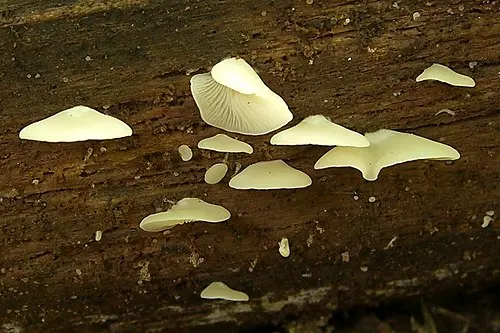 Jason Hollinger / CC BY 2.0