
About this fungus
Fragrant Funnel is a fungus in the Tricholomataceae family. Its habitat and field characteristics are summarised below.
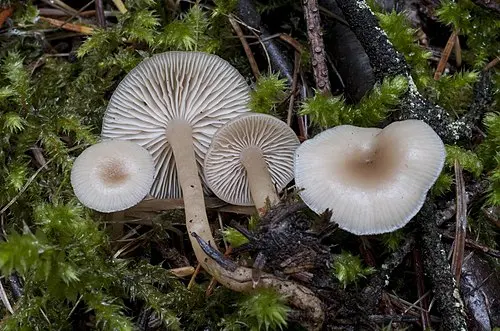
A small, pale funnel with a sweet aniseed smell, usually growing among leaves, moss or grass. Its cap is often shallowly depressed rather than deeply funnel-shaped, and the pale gills run a short way down the slender stem.
What to check
Check for a cap about 1 to 5 cm across, a smooth ringless stem, crowded whitish to pale buff gills that run down the stem, and a white spore print. A clear aniseed smell is useful supporting evidence, but it is not enough by itself because other funnel mushrooms can have a similar scent.
Variation
The cap is hygrophanous. It may look pale tan or yellowish brown when wet, often with a darker centre, then fade to cream or almost white as it dries. Older caps usually become flatter and more depressed.
Lookalikes
Aniseed Funnel, Clitocybe odora, is usually larger and often blue-green when young. Common Funnel, Infundibulicybe gibba, is generally larger and more deeply funnel-shaped. Small pale funnels are a difficult group that includes poisonous species, so colour, shape or scent alone should not be used to settle an identification.
Habitat and range
A ground-dwelling saprotroph found among leaf litter, moss, needles or grass in broadleaved, mixed and coniferous woodland, scrub and other lightly wooded places.
Food safety
Poisonous.
Photographs
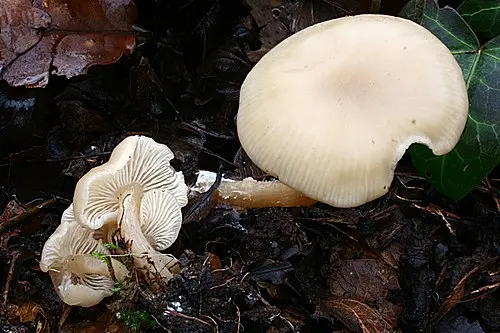 Strobilomyces / CC BY-SA 4.0
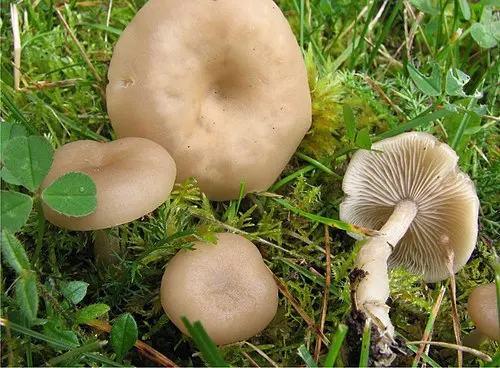 Irene Andersson (irenea) / CC BY-SA 3.0
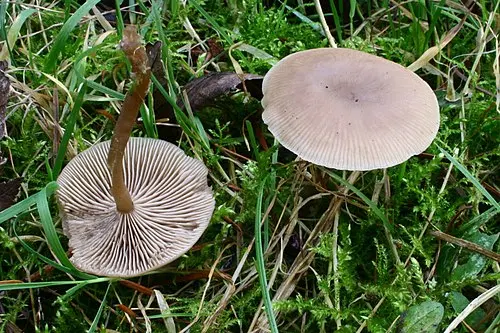 Strobilomyces / CC BY-SA 3.0
Species to compare
Similar mushrooms to compare against: