

About this fungus
Freckled Dapperling is a fungus in the Agaricaceae family. Its habitat and field characteristics are summarised below.
A robust dapperling with a pale to brown cap densely set with darker brown, pointed scales. Many scales stand upright like tiny pyramids, creating the rough hedgehog-like surface behind the name Echinoderma. The crowded white gills and conspicuous cottony ring contrast with the darker cap covering.
What to check
Look closely for genuinely raised, pointed cap scales rather than flat patches. The gills are white, free from the stem, crowded and often fork near the cap edge. A white partial veil becomes a cottony or membranous ring, sometimes with brown pointed scales along its lower edge, but the ring can collapse or disappear. The pale stem may carry scattered brown scales below the ring and ends in a slightly swollen base without a volva. The spore print is white.
Variation
The cap background ranges from cream to cinnamon or reddish brown, while the scales remain darker and may flatten or fall away with age. Young caps are rounded, conical or bell-shaped, then become broadly convex or almost flat and can retain a low central boss. The ring varies from broad and persistent to cobwebby and short-lived. Smell is also inconsistent, ranging from faint to strongly pungent, acidic or rubbery.
Lookalikes
Other Echinoderma species can be very similar. Echinoderma hystrix is usually darker and may have dark-edged gills, while Echinoderma calcicola differs in its cap covering and microscopic details. The Parasol has flatter cap scales, a patterned snake-skin stem and a thick movable ring. The Blusher is an Amanita with veil patches rather than pointed scales and its flesh reddens when damaged. Small Lepiota species include deadly amatoxin-containing fungi, but the old placement of Freckled Dapperling in Lepiota is not evidence that it contains amatoxins. Recent DNA research also shows that the name Echinoderma asperum currently covers several genetic lineages that photographs alone cannot separate.
Habitat and range
Saprobic in rich humus, leaf litter and woody debris. It occurs in broad-leaved and coniferous woodland, along woodland edges and paths, and in parks or gardens where woodchip mulch has been spread. Fruiting is mainly in summer and autumn, singly or in small scattered groups. The broad species concept is reported across Europe, North America and Asia, with recent research finding several geographically structured genetic clades.
Food safety
Poisonous.
Photographs
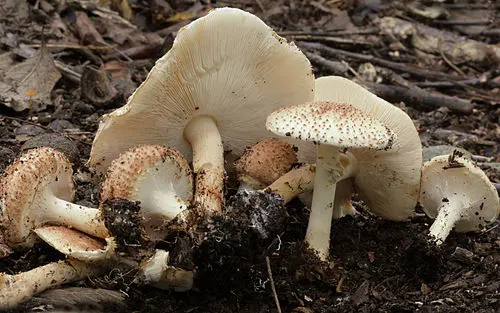 Christine Braaten; derivative by Ak ccm / CC BY-SA 3.0