

About this fungus
Frost's Bolete is a fungus in the Boletaceae family. Its habitat and field characteristics are summarised below.
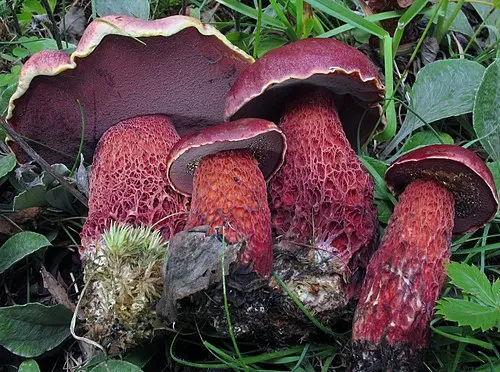
A spectacular American bolete whose cap, pore surface and strongly netted stem are all rich red. The cap is smooth and sticky when fresh, often with a narrow pale yellow overhang at the edge. Young moist pores may produce clear yellow or amber droplets. Pressing the pores brings a prompt blue stain, and cut pale flesh also turns blue.
What to check
Check the whole combination of a bright red sticky cap, dark red pores, prompt blue bruising and a deeply coarse-reticulate stem. The raised stem network is unusually bold and can resemble deep pockets or elongated honeycomb cells. Mature pores may become dull brownish red or yellowish near the margin. The cap is commonly 3. 5 to 8 cm across in modern North American accounts but larger examples to about 15 cm have been reported. The stem is commonly 4 to 12 cm tall. The spore print is olive-brown and the smooth spores are long and spindle-shaped. There is no ring or volva.
Variation
Young caps can carry a temporary pale bloom before becoming glossy bright red. With age, the cap may dull towards blood-red or brownish red and develop yellow patches, while the pore surface can fade from dark red towards dirty brown-red. Yellow droplets are a feature of fresh, moist young pores and are often absent later. Central American collections can have less red on the pores and stem than northeastern United States material. The same species is also published as Exsudoporus frostii and was formerly Boletus frostii.
Lookalikes
Use North American comparisons. Butyriboletus floridanus overlaps in the southeastern United States but usually has a less intensely red cap and a less strongly reticulate stem. The Boletus subvelutipes group has red pores and rapid blue bruising, but normally has a dry brown or olive-brown cap and little or no stem reticulation. Aureoboletus russellii has a deeply pocketed reddish stem, but its cap is dry, its pores are yellow and it does not show the same blue reaction. The European Devil's Bolete, Rubroboletus satanas, is not a normal geographic lookalike and has a pale cap with a short bulbous stem. Similar red-pored boletes can still be difficult, so cap texture, pore colour, bruising, stem surface and region all matter.
Habitat and range
Ectomycorrhizal with oaks and other broadleaf trees, fruiting on soil alone, scattered or in groups. It is widespread in eastern North America and also occurs in Texas, parts of the southwestern United States, Mexico and Central America, including montane oak forests. Fruiting is mainly in summer and autumn, with the timing following warm wet periods within its regional season. It is not a European species.
Food safety
Edible.
Use this profile to learn what to examine and compare, not as proof that a mushroom is safe to eat. Check the whole specimen and every important lookalike before reaching an identification.
Photographs
 Walt Sturgeon (Mycowalt) / CC BY-SA 3.0