
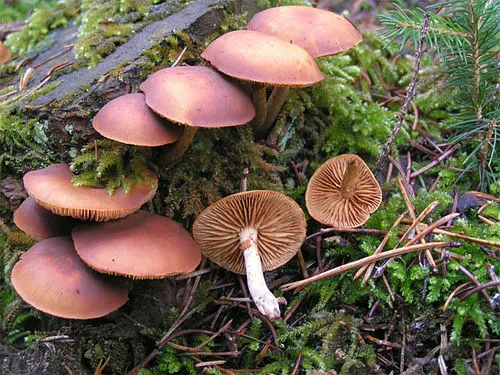
About this fungus
Funeral Bell is a fungus in the Hymenogastraceae family. Its habitat and field characteristics are summarised below.
A small brown mushroom that grows from dead wood. When damp, the smooth cap is usually honey, ochre or orange-brown, often with a paler edge. It fades towards tan as it dries. The gills begin pale yellow-brown and become rusty brown, while the slender stem is paler near the top and darker towards the base.
Identification features to check
Confirm that it is growing from wood, remembering that buried roots or logs can make it look ground-dwelling. Look for attached gills, a rusty-brown spore print and a thin ring or ring zone on the upper stem. The ring often collapses or disappears with age, so its absence does not rule the species out. There is no volva at the stem base.
Variation
The cap is strongly hygrophanous, so wet and dry specimens can look strikingly different. Moist caps are deeper honey-brown or orange-brown and may be finely lined at the edge. Drying can make them much paler and produce a two-toned appearance. The fragile ring is clearest on young mushrooms and may be almost impossible to see later.
Lookalikes
Funeral Bell overlaps in size, colour and habitat with several other small wood-growing mushrooms, including Wood Tuft, honey fungi, Velvet Shank and some Psilocybe species. White spores separate honey fungi and Velvet Shank from Funeral Bell, while Psilocybe spores are dark purplish-brown rather than rusty brown. These are useful comparisons, but mixed clusters and immature specimens can still mislead, and cap colour or a ring alone is not enough for a safe identification.
Food safety
Deadly poisonous. Funeral Bell contains amatoxins that can cause severe liver injury. Vomiting and diarrhoea may not begin until more than six hours after eating, so a person can be seriously poisoned before the danger is obvious. If ingestion is suspected, contact the local poison centre or emergency medical service immediately.
Photographs
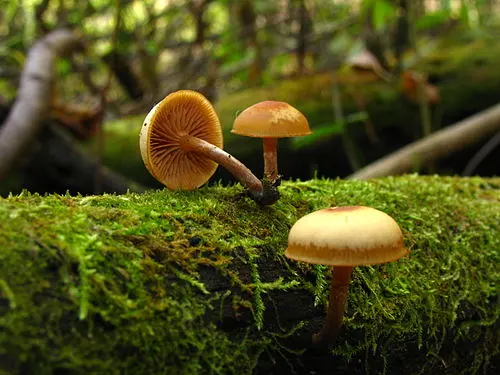 Dan Molter (shroomydan) / CC BY-SA 3.0
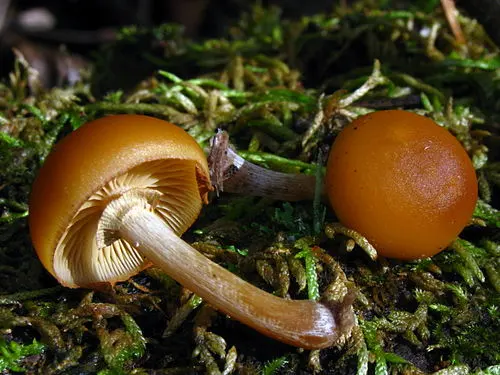 Dan Molter (shroomydan) / CC BY-SA 3.0