

About this fungus
Gassy Webcap is a fungus in the Cortinariaceae family. Its habitat and field characteristics are summarised below.
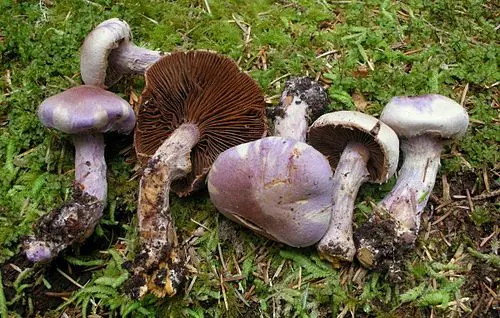
A stout conifer-woodland webcap with lilac to violet colours when young, a swollen stem and contrasting yellow-brown to saffron flesh. Its strong odour may seem fruity in fresh mushrooms and becomes pungent or unpleasant with age.
What to check
Young fruit bodies have a lilac cobweb-like cortina between cap and stem. The gills begin dull brownish or violet-brown and become rusty as spores mature. Check for a bulbous stem, yellowish to marbled brown flesh, a rusty-brown spore print and conifer habitat. Colour and odour are supporting characters, not a complete identification.
Variation
Lilac is strongest in young fresh specimens and fades toward tan, ochre or brown with age and weather. Mature gills become rustier, the cortina disappears, and the odour may change from pear-like or fruity to harsh and unpleasant.
Lookalikes
Cortinarius camphoratus and other violet webcaps can be very similar. Modern sequence work also shows that regional material formerly placed under broad webcap names may represent separate species, including North American concepts near Cortinarius pyriodorus. Microscopy, regional literature or DNA may be needed for a firm identification.
Habitat and range
Ectomycorrhizal on acidic or nutrient-poor soil in conifer forest, particularly with spruce, fir and pine. It is recorded across Europe and parts of northern North America, but regional taxonomic interpretation is important.
Food safety
Inedible.
Photographs
 Ron Pastorino (Ronpast) / CC BY-SA 3.0