

About this fungus
Geranium Brittlegill is a fungus in the Russulaceae family. Its habitat and field characteristics are summarised below.
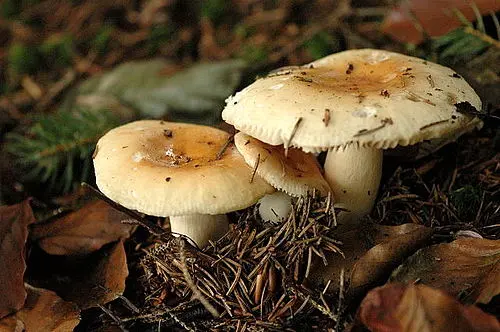
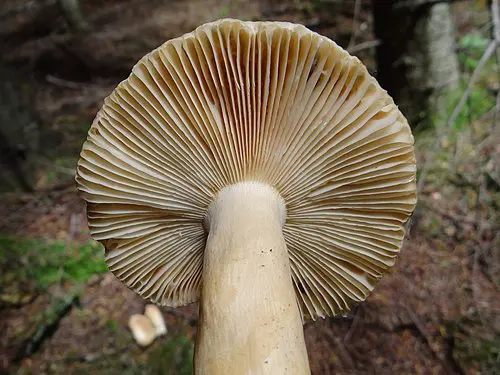
A firm straw-yellow to honey-buff brittlegill whose cap, gills and stem can all share a warm yellowish tone. Fresh mushrooms often have a sweet, leafy or fruit-like smell, but the strength and comparison vary between observers.
What to check
Look for a smooth cap that becomes flatter with a broad central boss or shallow dip, pale cream to straw gills, and a ringless stem that is usually similar in colour to the cap. The cap skin peels only part way towards the centre. Smell is a useful supporting clue when present, but exact identification may need a spore print and microscopy.
Variation
The whole fruit body ranges from pale straw through ochre-honey to buff, often darker at the cap centre. The smell has been compared with geranium leaves, stewed fruit and apples, and it can be faint in old or dry material.
Lookalikes
Ochre Brittlegill, Russula ochroleuca, and other yellow-buff Russula species overlap strongly in colour. Gill colour, cap-skin behaviour, tree partner, spores and microscopic cap structures are more dependable together than any smell or colour on its own.
Habitat and range
An ectomycorrhizal woodland species strongly associated with beech in much of Europe, with spruce also reported in parts of its range. It grows on the ground rather than on wood. Soil reaction is omitted here because available accounts are not consistent enough to make it a practical separator.
Food safety
Inedible.
Photographs
 James Lindsey / CC BY-SA 3.0
 Jerzy Opioła / CC BY-SA 4.0