

About this fungus
Giant Puffball is a fungus in the Agaricaceae family. Its habitat and field characteristics are summarised below.
A very large white ball or irregular globe on open ground, often football-sized or larger, with no separate cap, gills or obvious stem.
What to check
Section the entire fruit body from top to base. A young true puffball must be uniformly firm and pure white throughout, with no cap, gills, stem or other internal outline. Any yellow, olive, brown, purple or black area rules it out. There is no ring or volva.
Variation
The outside begins smooth to slightly lumpy and white, then becomes cream or yellowish. Inside, white flesh turns yellow-olive and finally powdery brown as spores mature. Size is impressive but does not replace the sectioning test.
Lookalikes
Earthballs have tougher skin and a dark purple-black or marbled interior. An immature Amanita has a developing cap, gills and stem visible when sectioned. Smaller puffballs can be similar externally, but no puffball is acceptable if the complete interior is not uniform white.
Habitat and range
Saprotrophic in nutrient-rich pasture, lawns, gardens, roadside verges and open woodland, sometimes in loose groups or rings. It occurs widely in temperate regions.
Food safety
Edible.
Use this profile to learn what to examine and compare, not as proof that a mushroom is safe to eat. Check the whole specimen and every important lookalike before reaching an identification.
Photographs
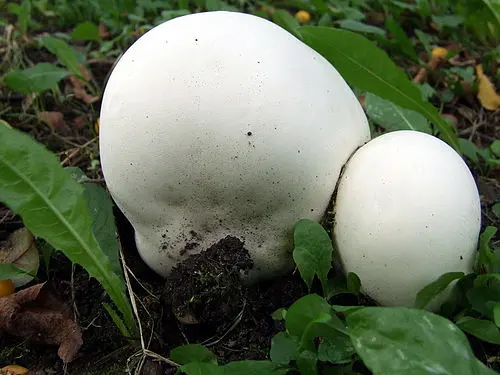 Tocekas / CC BY-SA 3.0
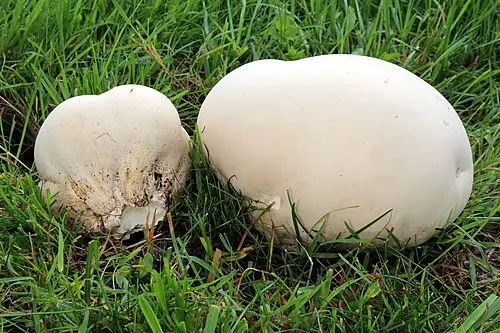 H. Krisp / CC BY 3.0