

About this fungus
Glistening Inkcap is a fungus in the Psathyrellaceae family. Its habitat and field characteristics are summarised below.
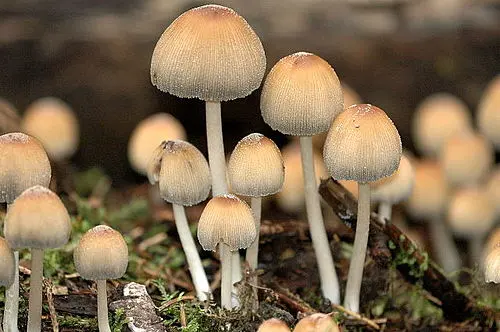
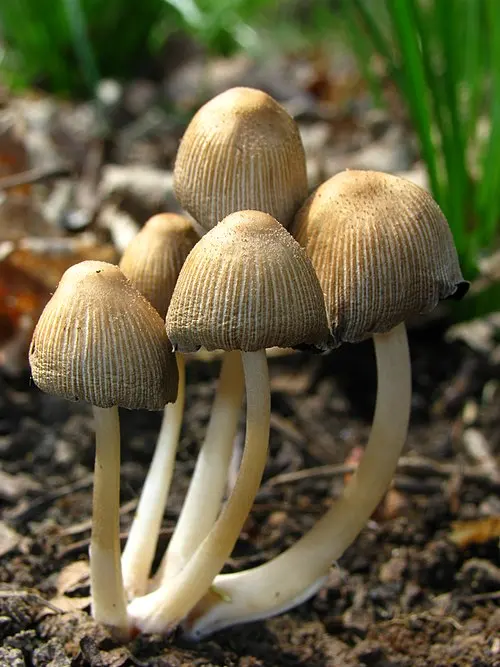
A fragile inkcap that often appears in crowded clusters around stumps or buried wood. Its oval young cap opens to a bell shape and is dusted with tiny glistening veil granules when fresh.
What to check
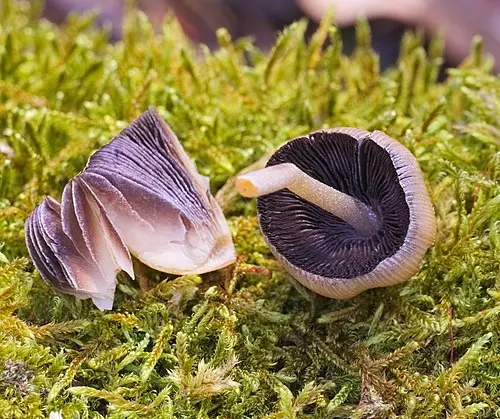
Look for a tan to ochre-brown cap with deep radial grooves and fine mica-like granules on young, dry specimens. The granules can wash away. Crowded gills begin white, become grey-brown or purplish brown, then blacken and may dissolve into ink. The pale stem has no ring or volva.
Variation
Young and old caps often occur together in one cluster. Rain can remove the diagnostic surface granules, while ageing darkens the gills and may leave the cap split, curled or partly dissolved.
Lookalikes
Coprinellus truncorum is extremely close and cannot always be separated in the field; spore shape and germ-pore details may be needed. Other small clustered inkcaps can also lose veil material in rain, so the granules alone do not prove the species.
Habitat and range
A wood-decaying fungus on broadleaf stumps, logs, buried roots and other woody debris. It may appear to grow from soil when the wood is hidden below the surface, and is widespread in temperate regions.
Food safety
Edible.
Use this profile to learn what to examine and compare, not as proof that a mushroom is safe to eat. Check the whole specimen and every important lookalike before reaching an identification.
Photographs
 James Lindsey / CC BY-SA 3.0
 Dan Molter (shroomydan) / CC BY-SA 3.0
 Andreas Eichler / CC BY-SA 4.0