

About this fungus
Golden Tops is a fungus in the Hymenogastraceae family. Its habitat and field characteristics are summarised below.
A fairly robust dung-loving mushroom of warm pastures. Its smooth cap is reddish brown to golden brown when moist but can dry through yellowish and greyish shades to almost white, often leaving a darker centre. Mature mushrooms usually carry a membranous ring on the pale stem, dark purple-brown gills and blue staining where tissue has been damaged.
What to check
Check the complete combination rather than any one feature. The cap is 1 to 8. 5 cm across, conical to convex when young and broadly convex to flat later. It is smooth and sticky when moist and changes colour as it dries. The gills are attached to narrowly attached, starting grey and becoming mottled purplish black while their edges stay paler. The hollow whitish stem is 4 to 15 cm tall and usually has a persistent white ring that becomes dark with fallen spores. The spore print is purple-black. Damaged flesh commonly turns blue, but blue staining also occurs in other fungi and is not proof of identity. There is no volva.
Lookalikes
Psilocybe subcubensis is so similar that spore size may be needed to separate it. Dung Roundhead, Protostropharia semiglobata, can share the same substrate and a purple-brown print, but has a sticky yellowish cap and stem and does not turn blue. Panaeolus species also occur on dung; their gills become distinctly mottled and their spore prints are black, although some species can also stain blue. Candolleomyces, Agrocybe and Stropharia species can resemble pale or dry examples but differ in their full combination of substrate, bruising, veil and spores. Small brown mushrooms include dangerous species, so neither habitat nor blue staining should be used alone.
Habitat and range
Saprotrophic and strongly associated with animal dung, especially in grazed grassland and agricultural settings. It is a tropical and subtropical species recorded across several continents, much of that range probably following livestock. Fruiting can occur throughout the year in humid tropical areas. In subtropical areas it is more seasonal and often follows heavy rain and higher humidity. It should not be assumed to occur naturally in cool temperate pasture simply because other mushrooms there are called gold tops.
Food safety
Psychoactive.
Photographs
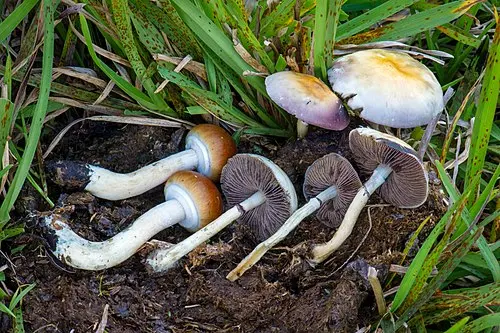 Alan Rockefeller / CC BY-SA 4.0
Species to compare
Similar mushrooms to compare against: