

About this fungus
Golden Waxy Cap is a fungus in the Hygrophoraceae family. Its habitat and field characteristics are summarised below.
A vivid North American waxcap with a smooth lemon-yellow to orange-yellow cap, pale yellow waxy gills and a fragile yellow stem. The cap is often glossy or slimy when fresh, but colour alone cannot separate it from several close relatives.
What to check
The 2 to 4. 5 cm cap starts convex and expands through broadly convex to almost flat. It is smooth, fragile and slimy when fresh. Gills begin nearly white, soon become pale yellow, and are narrowly attached or notched at the stem rather than running down it. The 4 to 10 cm yellow stem is smooth, fragile and easily split, with a white base and no ring. It may feel dry or greasy but is not reliably diagnostic by stickiness. The spore print is white.
Variation
Caps range from lemon-yellow to orange-yellow and may be more orange in the centre. Older or drier specimens lose some gloss and fade. Stem moisture varies between collections, which is why a simple sticky-versus-dry rule should not be used to name this species.
Lookalikes
Hygrocybe chlorophana is extremely similar, and the boundary between the names remains under study. Hygrocybe acutoconica normally has a more pointed cap and longer spores, while Hygrocybe parvula is smaller with a stem that is often pinkish-red. Microscopy, location and current regional treatments may be needed for a species-level record.
Habitat and range
The reviewed North American concept occurs on soil in woodland under hardwoods or conifers, often with coast redwood in the west and beech in the east. It fruits from spring to autumn, or into winter in warm climates. Its precise nutritional relationship with the surrounding habitat remains uncertain, so it should not be labelled simply as mycorrhizal. European grassland records usually belong under the closely related name Hygrocybe chlorophana rather than being assumed to be this species.
Food safety
Edibility is uncertain or disputed.
Photographs
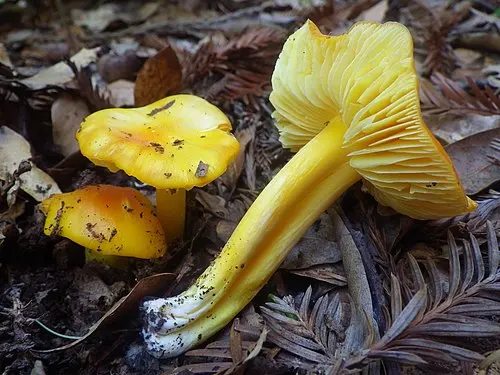 ESLP_Mycology / CC BY-SA 3.0
Species to compare
Similar mushrooms to compare against: