
About this fungus
Green Elfcup is a fungus in the Chlorociboriaceae family. Its habitat and field characteristics are summarised below.
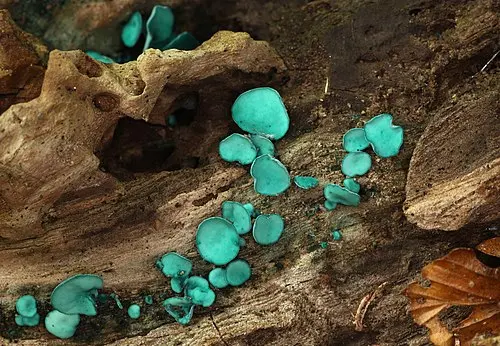
Tiny turquoise to blue-green cups grow from dead wood that has itself been stained the same remarkable colour. The coloured wood is seen far more often than the fruit bodies.
What to check
Look for small irregular cups with smooth blue-green inner surfaces, paler felted outer surfaces and short off-centre stems. Confirm that the bark-free dead wood is stained blue-green beneath the surface. These checks identify Chlorociboria, but not the exact species without microscopy.
Variation
The cups may be round, wavy or irregular and range from turquoise to deep green-blue. They are short-lived and easily overlooked, while the pigment in the wood can remain visible throughout the year.
Lookalikes
Chlorociboria aeruginosa is macroscopically almost identical and produces the same stained wood. C. aeruginascens generally has smaller spores, but reliable separation requires microscopic measurement. A photograph should normally be recorded as Chlorociboria species or Green Elfcup group unless microscopy is available.
Habitat and range
Saprobic on bark-free, decaying broadleaf wood, often oak and also beech, hazel and other hardwoods. The blue-green pigment xylindein has made stained wood valuable in decorative woodworking in both Europe and North America.
Food safety
Inedible.