

About this fungus
Green Russula is a fungus in the Russulaceae family. Its habitat and field characteristics are summarised below.
A stout green brittlegill whose mature cap breaks into darker angular patches on a paler background, creating a quilted appearance.
What to check
Look for the mosaic-like cap surface, brittle white to cream gills and flesh, and a stout white stem. The spore print is cream to pale yellow. There is no ring or volva. Confirm the whole structure because a green cap alone is not enough.
Variation
Young caps may be smooth and nearly white or grey-green before the cracked pattern develops. Mature caps range from pale green to olive or grey-green and can fade unevenly.
Lookalikes
Russula aeruginea and several regional green-cracked Russula species can overlap. In North America, green quilted mushrooms have often been assigned to R. parvovirescens or related taxa rather than European R. virescens. Death Caps may be greenish but have flexible flesh, a ring and a basal volva, features no Russula has.
Habitat and range
Mycorrhizal with broadleaf trees, especially oak, beech and related hosts, on woodland soil. The strict species is best established in Europe and Asia; similar North American collections need regional treatment.
Food safety
Edible, with caution.
Use this profile to learn what to examine and compare, not as proof that a mushroom is safe to eat. Check the whole specimen and every important lookalike before reaching an identification.
Photographs
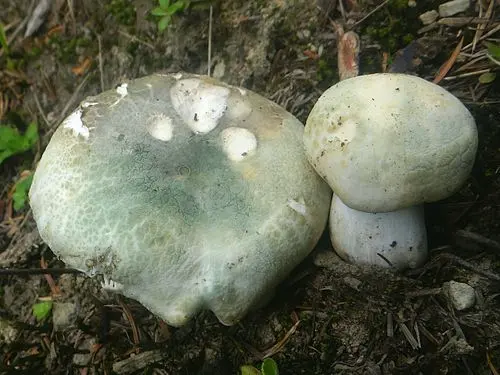 Jerzy Opioła / CC BY-SA 3.0
Species to compare
Similar mushrooms to compare against: