

About this fungus
Grey Knight is a fungus in the Tricholomataceae family. Its habitat and field characteristics are summarised below.
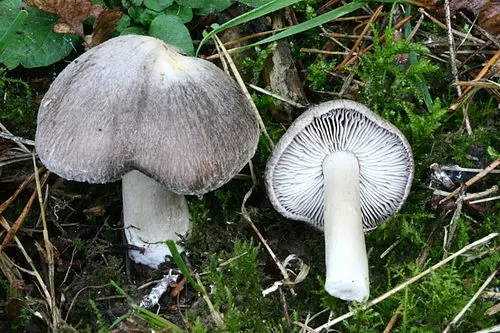
A grey woodland mushroom with a dry, finely downy or radially fibrous cap. Young caps are convex and often retain a low central bump as they flatten. The broad gills begin white and become grey with age, while the smooth stem remains whitish and has no ring.
What to check
Look closely at the cap texture rather than relying on grey colour alone. Fine grey to brown-grey fibres radiate from the centre, and the crowded gills meet the stem in a notch. Check for a white spore print, a ringless stem and growth with conifers. These features support an identification, but closely related grey knights may still require microscopic examination.
Variation
The cap ranges from pale silvery-grey to dark mouse-grey or brown-grey, and lighting can make the same mushroom appear warmer or cooler in tone. Older gills become greyer and may develop a faint yellow tinge. A very young cap can be more rounded and woolly at the edge than a mature, flatter specimen.
Lookalikes
The grey-capped Tricholoma group contains several very similar species. Tricholoma pardinum is usually larger, with a more clearly spotted or scaly cap and a mealy smell, and is poisonous. Other close relatives can be almost identical without microscopy. Colour by itself is not a reliable way to separate members of this group.
Habitat and range
A mycorrhizal species associated mainly with pine and also with spruce, fir and other conifers. It fruits on the ground, often in groups along woodland paths and clearings, and is frequently reported from neutral or calcareous soil. Comparable grey Tricholoma populations outside Europe may not always be the same species.
Food safety
Poisonous.
Photographs
 Strobilomyces / CC BY-SA 3.0