

About this fungus
Grey Spotted Amanita is a fungus in the Amanitaceae family. Its habitat and field characteristics are summarised below.
A solid European woodland Amanita with a grey-brown, umber-brown or olive-brown cap carrying irregular, mealy grey patches. The cap edge is normally smooth rather than grooved. Beneath it are crowded white gills and a stout pale stem with a broad skirt-like ring. The robust form traditionally called var. spissa supplies the familiar Grey Spotted Amanita appearance, while var. excelsa is generally paler and more slender.
What to check
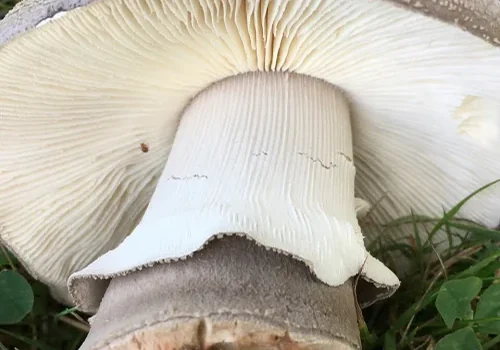
Examine the intact stem base, cap edge and both sides of the ring. The base enlarges gradually into a bulb and carries two to five crumbly ochre-grey veil zones, not a loose sac or a sharp gutter-like collar. The upper surface of the broad ring is strongly grooved, while the cap margin is normally not grooved. Veil pieces on the cap are grey, thin and mealy, and can be wiped or washed away. The crowded white gills are narrowly attached rather than broadly running down the stem. Cut flesh remains white instead of blushing pink or red. A white print and broadly ellipsoid amyloid spores support the identification.
Variation
Cap colour runs from pale grey-brown through umber to olive-brown, and the mealy veil patches vary from obvious irregular islands to almost nothing after heavy rain. The robust spissa form and the more slender nominal form overlap enough that some authorities treat them as minor variation rather than dependable varieties. Stem bases can be strongly bulbous or only a little wider than the stem, and the fragile lower veil zones may nearly disappear. Odour is also inconsistent, described as faintly grassy, radish-like or simply unpleasant. These shifting details make structure more useful than overall colour.
Lookalikes
Panthercap, Amanita pantherina, is the central safety comparison. It more typically has bright white regular warts, a clearly grooved cap margin, a smooth upper ring and a sharp collar or gutter around the bulb. Grey Spotted Amanita instead has grey mealy patches, a smooth cap margin, a grooved ring and crumbly zones around a more gradually enlarged base. Rain, damage and age can remove veil material, so no single difference is enough. Panthercap contains ibotenic acid and muscimol and can cause vomiting, agitation, hallucinations, marked drowsiness, coma and sometimes a need for intensive care, but it is not the delayed liver-failure syndrome of Death Cap. Blusher, Amanita rubescens, shares a grooved ring but its damaged flesh turns pink or reddish; Grey Spotted Amanita flesh stays white.
Habitat and range
Mycorrhizal on woodland soil with both conifers and broadleaf trees. European specialist accounts list fir, spruce, pine, oak and beech, with fruit bodies appearing from summer into autumn. The species was originally described from Sweden and is well established across Europe. Its name has often been applied to different Amanita in eastern North America and elsewhere, so a grey-spotted Amanita outside Europe should be checked against regional species rather than assigned this name from appearance alone.
Food safety
Edibility is uncertain or disputed.
Photographs
 Jon Sullivan / CC BY 4.0