

About this fungus
Hintapink Brittlegill is a fungus in the Russulaceae family. Its habitat and field characteristics are summarised below.
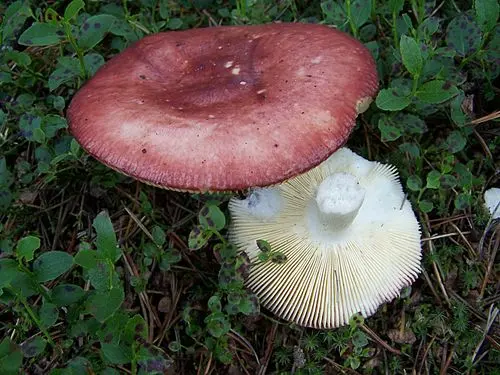
A large, sturdy brittlegill with a red, pink or red-brown cap, pale gills and an unusually long white stem. Like other Russula species, its flesh snaps and crumbles rather than bending in fibres.
What to check
Check for crowded gills that mature from cream towards pale ochre, a deep cream to light ochre spore print, and a cap that flattens and usually develops a shallow central dip. The stem can have a pink flush but may remain white. There is no ring or volva. These features support the name, but close red brittlegills may require microscopy.
Variation
Caps range from apple pink and blood red to purplish red, orange-brown or ochre, sometimes with faded patches. Stem colour and the strength of the pink flush also vary, so neither feature settles the species alone.
Lookalikes
The Sickener, Russula emetica, and several other red brittlegills can share the same colours and wet conifer habitat. Cap colour, stem blush and smell are supporting clues only. Spore colour, mature shape, microscopic spores and the regional species concept may all be needed for a dependable species name.
Habitat and range
Ectomycorrhizal with conifers, especially pine and spruce, on damp mossy or peaty ground and in bog-edge woodland. It is well established in northern Europe; reports elsewhere may include very similar regional Russula species. It is listed as edible in parts of Europe, but the app uses caution because red brittlegills are difficult to separate reliably.
Food safety
Edible.
Use this profile to learn what to examine and compare, not as proof that a mushroom is safe to eat. Check the whole specimen and every important lookalike before reaching an identification.
Photographs
 Jerzy Opioła / CC BY-SA 3.0