

About this fungus
Honey Mushroom is a fungus in the Physalacriaceae family. Its habitat and field characteristics are summarised below.
A robust honey-yellow to brown mushroom that commonly forms dense overlapping clusters from tree bases, buried roots and stumps. Its pale gills, stem ring and white spore deposit are important because several unrelated wood-growing mushrooms also fruit in clusters.
What to check
Look for a 5 to 15 cm cap with fine darker scales, especially near the centre, crowded pale gills that become yellowish and rust-spotted with age, and a pale persistent ring on the stem. The gills are attached or run slightly down the stem, and the spore print is creamy white. Black bootlace-like rhizomorphs or a pale fungal sheet beneath bark strongly support Armillaria, but they do not by themselves prove this exact species. There is no volva.
Variation
Caps range from honey-yellow through tawny to red-brown, with scales that can become faint on expanded or rain-washed caps. Fruit bodies may arise from buried roots and appear to grow from soil. Honey fungus is a group of several similar Armillaria species, so colour and clustering alone are not enough for a species-level identification.
Lookalikes
Other Armillaria species can be extremely similar. Dark Honey Fungus has dark scales beneath its ring, while Ringless Honey Fungus lacks a ring. Shaggy Scalycap has coarser scales, gills that become uniformly rust-brown and a brown spore print. Deadly Funeral Bell can also grow on wood and has a brown spore print; small or atypical clusters should never be identified from cap colour alone.
Habitat and range
A root and butt pathogen of living woody plants that also decomposes dead roots, stumps and fallen wood. Armillaria mellea is especially associated with broadleaved hosts in European accounts, but the wider honey fungus group attacks many woody plants, including conifers, across temperate regions.
Food safety
Edible, with caution.
Use this profile to learn what to examine and compare, not as proof that a mushroom is safe to eat. Check the whole specimen and every important lookalike before reaching an identification.
Photographs
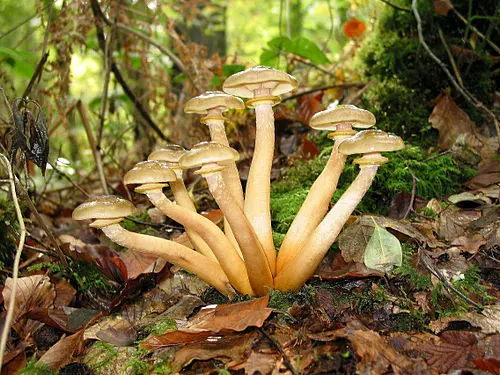 Jean-Pol GRANDMONT / CC BY 3.0
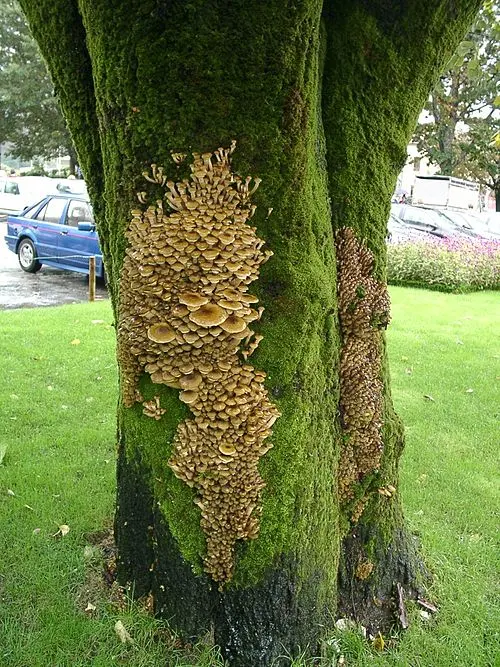 Júlio Reis (Tintazul) / CC BY-SA 2.5
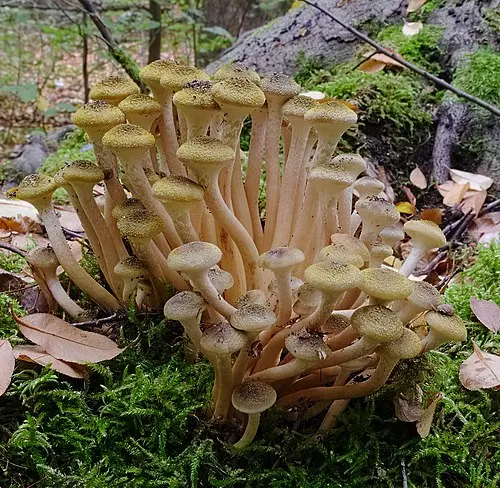 Andreas Eichler / CC BY-SA 4.0