

About this fungus
Hooded False Morel is a fungus in the Discinaceae family. Its habitat and field characteristics are summarised below.
A brittle woodland fungus with a brown cap folded into a loose two-lobed saddle, rather like a pointed hood on a pale stem. The upper surface is smooth to loosely wrinkled rather than covered in the regular pits of a true morel. This species is now placed in the genus Paragyromitra by some current taxonomic authorities, although GBIF still accepts the familiar name Gyromitra infula.
What to check
Look for two prominent raised lobes, sometimes three or four, on a cap that is tan, yellow-brown, reddish-brown or dark brown. The cap underside is paler and finely downy, and parts of its edge may join the stem. The stem is usually pale, softly textured and folded near the base but not sharply ribbed. Cut the whole fruit body lengthways: the flesh is thin and brittle, and the interior is irregular or chambered rather than one clean hollow cavity. A cap shape alone is not enough for a firm identification because the closest relative may require microscopic spore examination.
Variation
The tidy two-pointed saddle is only the common form. Caps can be cup-like when young, unevenly two-lobed, three-lobed or highly irregular, and clustered fruit bodies may distort one another. Colour ranges from pale tan through yellow-brown and red-brown to very dark brown. The stem can be almost white, buff, pinkish-brown or grey-brown, and western North American collections may become larger and more irregular than eastern ones. The spore deposit is white to pale cream or faintly yellowish.
Lookalikes
Paragyromitra ambigua, long known as Gyromitra ambigua, can be almost identical in the field. It is often smaller, darker and more violet-toned, but these tendencies overlap; its longer, more pointed spores provide the dependable distinction. Gyromitra esculenta usually fruits in spring and has a more tightly convoluted, brain-like cap. True morels, Morchella species, have a regular network of pits and ridges and are continuously hollow from cap to stem when cut lengthways. Saddle-shaped Helvella species are generally thinner and often have a more strongly ribbed or fluted stem. Old, deformed specimens may need microscopy rather than a confident photograph-only name.
Habitat and range
Saprotrophic, most often on well-rotted conifer wood or rich woody debris in coniferous and mixed woods. It also fruits on soil close to old stumps, buried wood, paths, verges, campsites and other disturbed places. Across much of its range it appears from late summer into autumn, while coastal California collections may fruit in winter or spring. Records extend across North America, Central America, Europe and Asia, especially in northern or montane forest regions.
Food safety
Poisonous.
Photographs
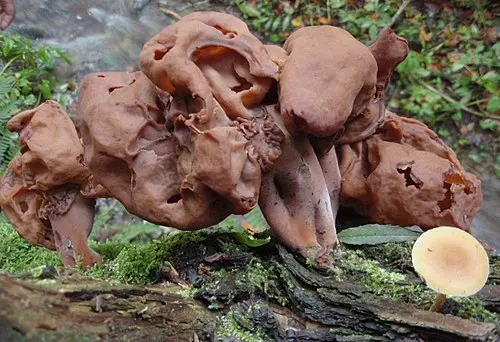 Horst74 / CC BY 3.0