

About this fungus
Hoof Fungus is a fungus in the Polyporaceae family. Its habitat and field characteristics are summarised below.
A hard perennial bracket shaped like a horse's hoof, with a grey concentrically zoned crust and a pale pore surface underneath.
What to check
Look for a broad attachment to a broadleaf trunk, a hard grey crust with annual growth zones, tiny round pores underneath, and tough cinnamon-brown flesh. New tube layers are added over several years. It has no stem, ring or volva.
Variation
Young growing edges are pale brown to grey-white. Older upper surfaces become darker grey or nearly black, while the pore surface starts pale and browns after handling or age.
Lookalikes
Birch Polypore is annual, smoother and usually rounded rather than strongly hoof-shaped. Ganoderma species produce brown spores, while Hoof Fungus has a very pale lemon spore deposit.
Habitat and range
Parasitic on living broadleaf trees and saprotrophic after the wood dies, causing white rot. Birch and beech are frequent hosts, but poplar, maple and other hardwoods are used in different regions.
Food safety
Inedible.
Photographs
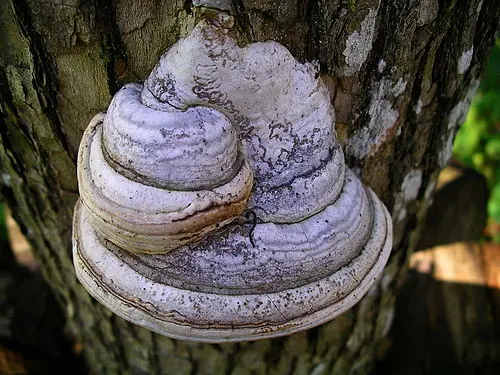 Photographer and licence not recorded in current app
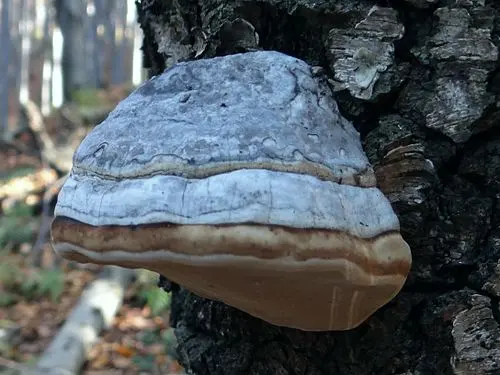 Jerzy Opioła / CC BY-SA 3.0