

About this fungus
Horn of plenty is a fungus in the Cantharellaceae family. Its habitat and field characteristics are summarised below.
A thin dark-grey to black woodland fungus shaped like a hollow trumpet, often clustered and easily hidden among leaf litter.
What to check
Confirm that the fruit body is hollow to the base and has no true gills or pores. The outer fertile surface is grey and smooth to finely wrinkled, while the inner funnel is darker and often slightly scaly. There is no ring or volva.
Variation
Fresh wet specimens are charcoal-grey to nearly black; dry ones become much paler grey-brown. Margins become increasingly wavy and split with age.
Lookalikes
Grey Chanterelle has a more clearly ridged or vein-like outer fertile surface and can be difficult to separate in photographs. Winter Chanterelle has strong yellow-grey ridges and usually a yellowish stem. Regional Craterellus species may need microscopy or DNA.
Habitat and range
Ectomycorrhizal in broadleaved woodland, especially with beech and oak on moist calcareous or otherwise base-rich soil. The strict species is widespread in Europe, with related black trumpets in other regions.
Food safety
Choice edible.
Use this profile to learn what to examine and compare, not as proof that a mushroom is safe to eat. Check the whole specimen and every important lookalike before reaching an identification.
Photographs
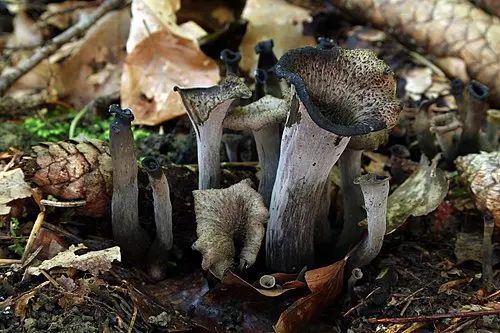 H. Krisp / CC BY 3.0
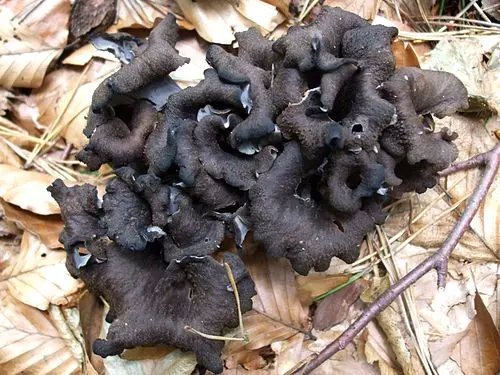 Tomasz Przechlewski / CC BY 2.0