
About this fungus
Indigo Milk Cap is a fungus in the Russulaceae family. Its habitat and field characteristics are summarised below.
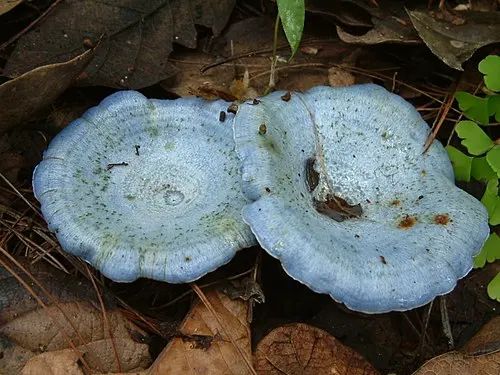
A striking indigo-blue milkcap with concentric cap zones, blue gills and a blue stem. Damaged tissue develops greenish staining as the blue pigment changes.
What to check
Check several characters together: a deep to silvery blue cap, blue crowded gills, a brittle stem often marked with shallow darker pits, and deep indigo-blue latex from fresh damage that becomes dark green on exposure. Older or dry fruit bodies may release little latex. There is no ring or volva.
Variation
Young caps are convex with an inrolled edge and are often sticky. They flatten and become depressed or broadly vase-shaped, fading from deep indigo to grey-blue or silvery blue. Bruising, age and weather can create green, olive or brownish areas.
Lookalikes
Lactarius paradoxus can begin blue-grey but develops reddish-brown to purple-brown latex and warmer cap colours. Lactarius chelidonium has yellowish to brown latex. Other blue milkcaps occur in parts of Asia and the Americas, and the broad name Lactarius indigo may contain more than one regional lineage. Confirm latex colour and colour change, not blue cap colour alone.
Habitat and range
Mycorrhizal on soil with oaks and pines in parts of North, Central and South America and Asia. It occurs in both broadleaved and conifer woodland, but published North American accounts do not support a special dependence on flooded ground and report it absent from some western regions.
Food safety
Edible.
Use this profile to learn what to examine and compare, not as proof that a mushroom is safe to eat. Check the whole specimen and every important lookalike before reaching an identification.
Photographs
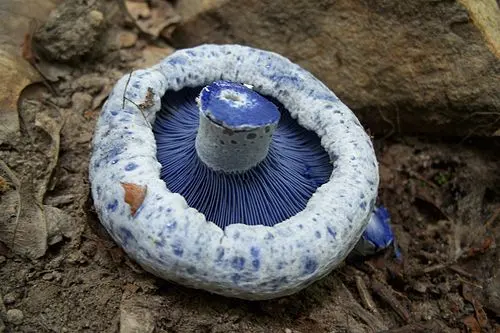 Eddee / CC BY-SA 3.0