

About this fungus
Inky Agaricus is a fungus in the Agaricaceae family. Its habitat and field characteristics are summarised below.
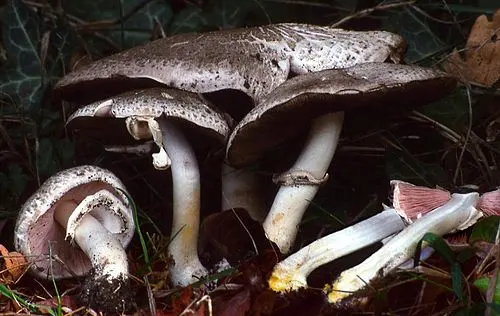
A woodland Agaricus with a whitish or cream cap finely patterned by grey-brown to nearly black scales, usually darkest over the centre. It has free gills, a substantial hanging ring and the familiar solid build of a field mushroom, but damaged flesh often releases an unpleasant inky or phenolic smell.
What to check
Lift the complete stem base and cut it lengthways. The strongest useful reaction is an immediate bright yellow at the bulbous base, later fading to brown; cap-edge staining may be weaker and old or dry specimens can react poorly. Check the chemical smell from freshly damaged flesh, which may resemble ink, iodine, carbolic soap or kerosene and often strengthens during cooking. The crowded free gills begin pale grey-pink, become pink and mature to dark chocolate-brown. A large white ring hangs from the upper stem, with no volva.
Variation
Cap scaling ranges from cold grey-brown to almost black and varies from fine fibres to more obvious scales, but remains densest at the centre. Young caps are rounded, then broadly convex and eventually flat. The yellow reaction depends on freshness, age and the part tested, which is why the stem base matters more than a casual rub of the cap. Smell can also be faint outdoors but becomes clearer after cutting or heating.
Lookalikes
The Yellow Stainer shares the chemical smell, yellow stem base and toxicity but usually has a smoother, paler cap without the dark central scaling. Field Mushroom does not develop the same vivid yellow at the stem base and lacks the phenolic smell. The Prince is larger, has coarser brown scales and usually smells pleasantly of almond rather than ink. Species names must follow geography: Agaricus placomyces is the similar eastern North American species, while western North America has other dark-scaled members of the yellow-staining group. The visible field characters can identify the toxic group more confidently than the exact regional species.
Habitat and range
Saprobic in rich soil and humus, most often in deciduous or mixed woodland, under hedgerows, in parkland and on roadside verges. It often favours nutrient-rich alkaline ground and fruits singly or in small groups from summer into autumn. The DNA-supported Agaricus moelleri concept is widespread in Europe. Older North American records often belong to Agaricus placomyces or other regional relatives and should not automatically be carried over under this name.
Food safety
Poisonous.
Photographs
 Zonda Grattus / CC BY 3.0