

About this fungus
Ivory Woodwax is a fungus in the Hygrophoraceae family. Its habitat and field characteristics are summarised below.
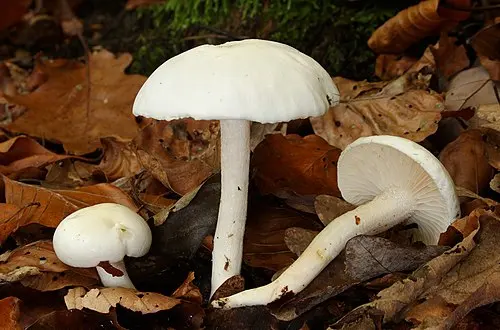
An ivory-white woodland mushroom with a conspicuously glutinous cap and stem. Its thick, widely spaced waxy gills run down the stem, giving a much fleshier build than white grassland waxcaps.
What to check
Check that both cap and most of the stem are slimy, the white waxy gills are distant and decurrent, and there is no ring or volva. Record the tree partner, location, odour and any yellow-brown discoloration. White Hygrophorus in this group can require microscopy and DNA.
Lookalikes
Hygrophorus discoxanthus develops stronger yellow-brown discoloration, while Hygrophorus cossus has differing odour and oak ecology in European treatments. Cuphophyllus virgineus is a smaller grassland waxcap. North American white woodwaxes include a sister lineage still often called H. eburneus and other unresolved taxa.
Habitat and range
The European concept is mycorrhizal mainly with beech in broadleaved woodland. North American collections currently placed under the same name form a closely related molecular lineage and may not be identical. Similar white woodwaxes occur in Asia and require regional treatment.
Food safety
Edible.
Use this profile to learn what to examine and compare, not as proof that a mushroom is safe to eat. Check the whole specimen and every important lookalike before reaching an identification.
Photographs
 H. Krisp / CC BY 3.0