
About this fungus
Jackson's Slender Caesar is a fungus in the Amanitaceae family. Its habitat and field characteristics are summarised below.
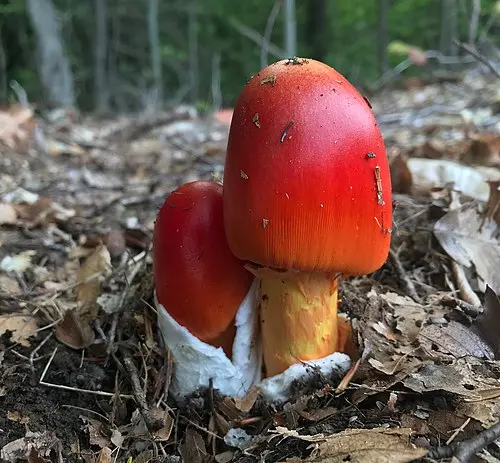
A slender eastern North American Caesar mushroom with a vivid red-orange cap, yellow gills and stem, a yellow skirt-like ring and a large white sack at the stem base.
What to check
Check the whole fruit body. The cap is smooth and strongly lined at the margin, the gills are yellow and free or only narrowly attached, and the yellow stem carries orange-red fibres and a yellow to orange ring. Carefully expose the large white sack-like volva at the base. A white spore print supports the identification, but does not separate it from every Amanita.
Variation
The cap begins bright red to orange-red and commonly fades from the margin inward through orange to yellow. The ring may be fragile or partly collapsed, while orange fibres on the yellow stem vary in strength.
Lookalikes
It belongs to a North American group of closely related Caesar mushrooms that can require geography and specialist study to separate. Amanita caesarea is a European and North African species. Amanita parcivolvata lacks the large sack-like volva and persistent skirt-like ring. Other red or orange Amanita species can be toxic, and some deadly Amanita species share a ring and volva, so colour alone is never enough.
Habitat and range
Mycorrhizal with oak and pine in eastern North America, from eastern Canada through the eastern United States and into Mexico as part of a wider species group. Similar western and Mexican Caesar mushrooms may represent other species.
Food safety
Edible, with caution.
Use this profile to learn what to examine and compare, not as proof that a mushroom is safe to eat. Check the whole specimen and every important lookalike before reaching an identification.
Photographs
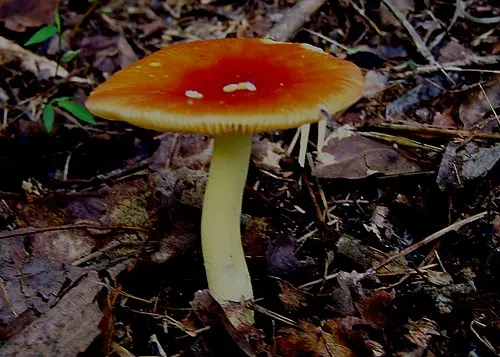 William Tanneberger / CC BY-SA 2.5