
About this fungus
Jelly Ear is a fungus in the Auriculariaceae family. Its habitat and field characteristics are summarised below.
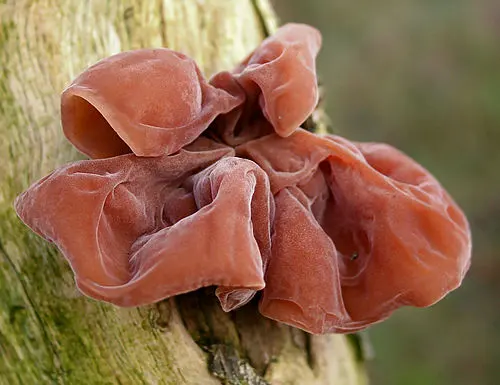
A soft, rubbery European wood-decay fungus forming reddish-brown ear-shaped or folded lobes directly from bark. Fresh fruit bodies are gelatinous, with a finely downy outer face and a smoother, often wrinkled inner face.
What to check
Fresh lobes are flexible and gelatinous rather than fleshy, usually 3 to 12 cm across and attached laterally to dead or weakened broadleaf wood. The outer face is minutely hairy and duller, while the fertile inner face is smoother and often veined or wrinkled. Dry fruit bodies shrink into hard dark folds but swell again after rain. The spore print is white.
Variation
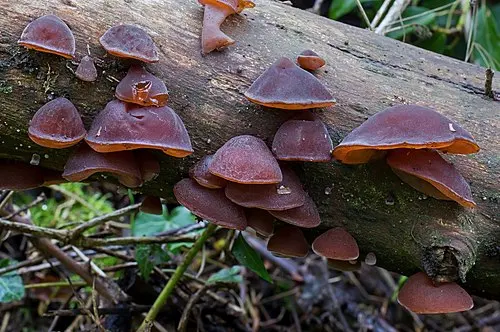
Moist specimens are plump and range from tan-brown to reddish or purplish-brown. Drying makes them thinner, harder and almost black, and old lobes may lose a clear ear outline. Rehydration changes size and texture dramatically, so compare several states when possible.
Lookalikes
Auricularia mesenterica forms more bracket-like, densely hairy, zoned tiers. Similar wood ears outside Europe belong to several species that were historically grouped under this name. North American hardwood collections are generally Auricularia angiospermarum, while the important cultivated Chinese black fungus is Auricularia heimuer. Geography, substrate and sometimes microscopy or DNA are needed for a strict species name.
Habitat and range
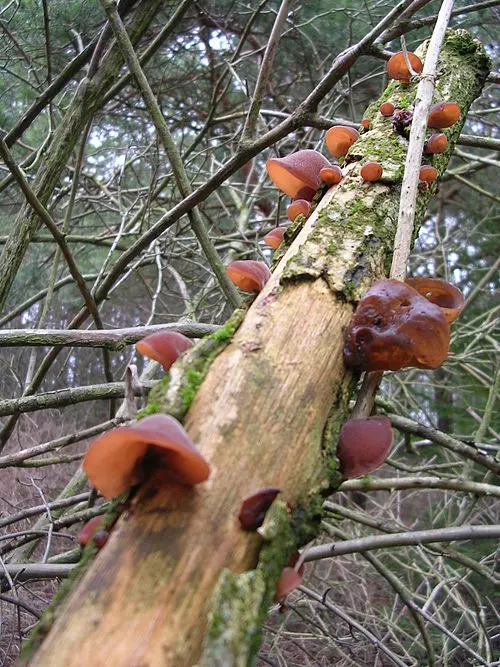
Saprobic and sometimes weakly parasitic on broadleaved wood. Elder is the classic European host, but sycamore, beech, ash and other trees are also recorded. It can fruit throughout the year in damp conditions, often reviving after rain.
Food safety
Edible.
Use this profile to learn what to examine and compare, not as proof that a mushroom is safe to eat. Check the whole specimen and every important lookalike before reaching an identification.
Photographs
 Tomasz Przechlewski / CC BY 2.0
 Stu's Images / CC BY-SA 3.0