

About this fungus
Larch Bolete is a fungus in the Suillaceae family. Its habitat and field characteristics are summarised below.
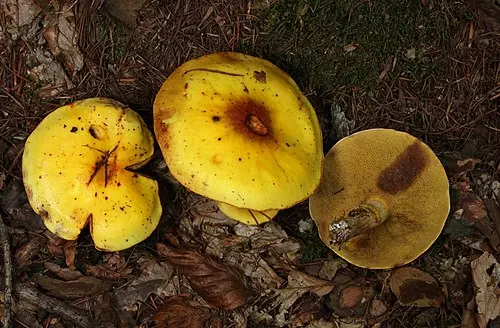
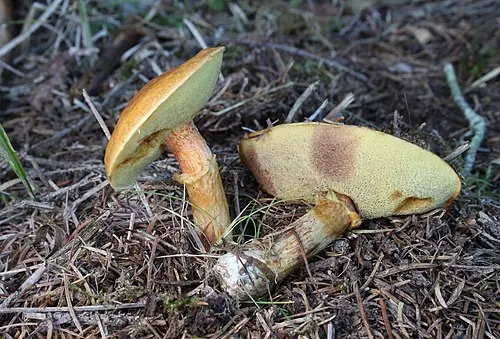
A glossy, sticky yellow to orange bolete beneath larch, with yellow pores and a thin ring or ring zone on the stem. It often fruits in lines or arcs following roots.
What to check
Confirm pores rather than gills and identify the nearby larch. Young fruit bodies have a pale veil over the pores; it leaves a thin, often collapsing ring or a paler band on the stem. Pores begin lemon-yellow and may become cinnamon-toned or rusty-brown after handling.
Variation
Caps range from pale yellow through chrome-yellow to orange or rusty orange-brown, becoming broader and sometimes wavy with age. Wet caps are strongly viscid and dry ones remain glossy. The ring can be obvious when young and inconspicuous later.
Lookalikes
Granulated Bolete lacks a ring and is associated mainly with pines rather than larch. In North America, Suillus clintonianus is the common grevillei-like partner of native larches and is often redder or darker; old colour alone may not separate them, and microscopy or DNA can be needed. Other larch-associated Suillus should also be considered regionally.
Habitat and range
Ectomycorrhizal with larches. The strict species is widespread in Europe and has travelled with planted European larch to parts of North America, New Zealand and elsewhere. Grevillei-like mushrooms under native North American larches are often S. clintonianus.
Food safety
Edible.
Use this profile to learn what to examine and compare, not as proof that a mushroom is safe to eat. Check the whole specimen and every important lookalike before reaching an identification.
Photographs
 H. Krisp / CC BY 3.0
 H. Krisp / CC BY 3.0