

About this fungus
Lead Grey Puffball is a fungus in the Agaricaceae family. Its habitat and field characteristics are summarised below.
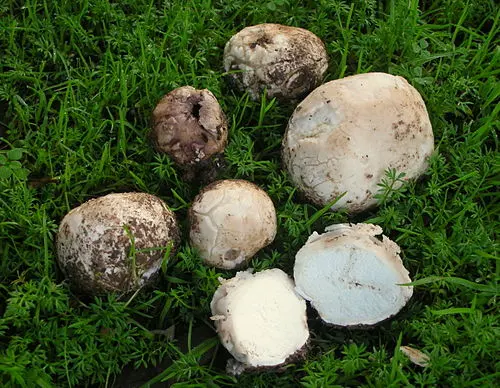
A small round puffball of short grass. It begins white, then its thin outer layer flakes away to reveal a smooth lead-grey inner wall, and mature fruit bodies often break free and roll in the wind.
What to check
Section the entire fruit body from top to base. A young true puffball must be uniformly firm and pure white throughout, with no cap, gills, stem or other internal outline. The outer white layer later flakes to lead-grey and the inside becomes olive-brown then powdery brown. There is no ring, volva or true stem.
Variation
Fresh fruit bodies are smooth and white. Peeling or weathering exposes the grey inner wall, while fully mature specimens become grey-brown, light and mobile.
Lookalikes
Earthballs have a tougher thick skin and develop a dark purple-black or marbled interior. An immature Amanita may be white outside but shows the outline of a cap, gills or stem when sectioned. Dusty Puffball becomes much darker brown to blackish rather than lead-grey.
Habitat and range
Saprotrophic in short grass, including pasture, lawns, golf courses and dune grassland. Mature detached fruit bodies may roll away from their original fruiting spot.
Food safety
Edible.
Use this profile to learn what to examine and compare, not as proof that a mushroom is safe to eat. Check the whole specimen and every important lookalike before reaching an identification.
Photographs
 Ron Pastorino / CC BY-SA 3.0
Species to compare
Similar mushrooms to compare against: