

About this fungus
Lilac Bonnet is a fungus in the Mycenaceae family. Its habitat and field characteristics are summarised below.
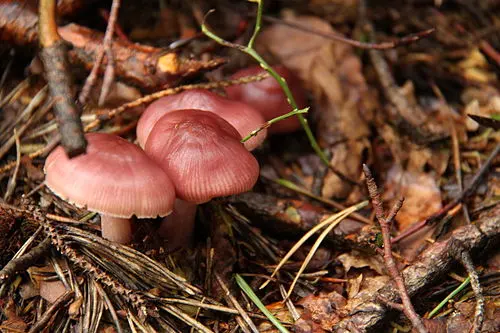
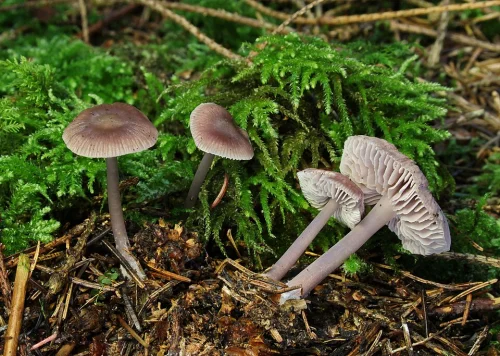
A delicate but fairly substantial bonnet mushroom of woodland litter, often recognised by a lilac, violet-grey or pink cap and a similar flush on the stem. The moist cap has fine translucent lines around its edge and begins bell-shaped before broadening. Colour is memorable but unusually changeable, so the name Lilac Bonnet describes only part of its appearance.
What to check
Check a complete fruit body for a 2 to 5 cm smooth cap, pale gills attached to the stem and a hollow, often slightly curved or twisted stem without a ring. The gills may run down the stem by a very short tooth and often develop small cross-veins with age. Gently crushing part of the cap can release a radish-like odour, although the smell may occasionally be weak or absent. A white spore print and smooth amyloid spores support the group. Colour and smell can establish the traditional Mycena pura field concept, but modern work found eleven mostly cryptic lineages within it, and even the usual fungal DNA barcode was unreliable on its own.
Variation
Fresh caps range through lilac, violet-grey, pinkish-grey and dusky purple, then often fade from the centre in dry weather. White, yellow and pale blue-grey forms are also documented. Caps can be bell-shaped, convex, almost flat, slightly umbonate or shallowly depressed, and old edges may turn upwards. Gills and stems may be nearly white or carry the same pale pink or violet wash as the cap. Genetic lineages do not map neatly onto these colour forms, so assigning a formal variety from colour alone gives false precision.
Lookalikes
Rosy Bonnet, Mycena rosea, is usually larger and more robust with a cleaner, more even rose-pink colour and often a widened stem base. Molecular work supports it as separate, although older accounts sometimes treated it as part of Mycena pura. Mycena diosma can share purple tones but has much darker violet-brown gills and a sweet, perfumed or cigar-box smell before becoming radish-like when damaged. Mycena pelianthina is marked by distinctly dark purple-black gill edges. These comparisons help with named morphospecies, but the hidden lineages inside the Mycena pura complex generally need multi-gene evidence rather than a photograph.
Habitat and range
Saprobic among fallen leaves, needle litter and humus in both broadleaf and coniferous woodland. It grows singly, scattered or in small groups and is less often recorded in open grassland or heath. Summer and autumn are the main seasons across northern Europe, while regional accounts extend from spring into winter in milder parts of North America. Because the field name covers several cryptic lineages, apparent worldwide habitat differences may partly reflect more than one species.
Food safety
Poisonous.
Photographs
 Slick / CC0
 Holger Krisp / CC BY 3.0