
About this fungus
Lobster Mushroom is a fungus in the Hypocreaceae family. Its habitat and field characteristics are summarised below.
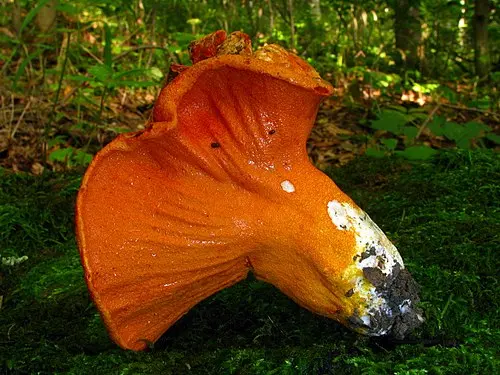
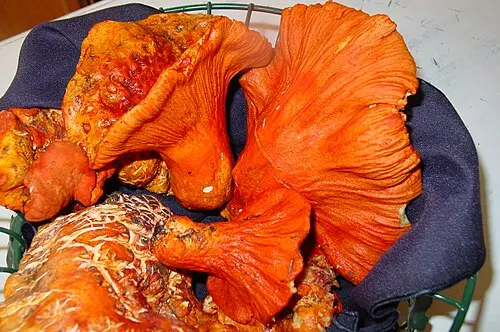
A bright orange to orange-red parasitic fungus that transforms a Brittlegill or Milkcap into a firm, contorted fruit body. Its hard, finely pimply crust covers most or all of the host, while the original gills are reduced to blunt folds or disappear beneath the coating.
What to check
Look for a vivid orange-red, finely bumpy and somewhat hardened outer layer, white brittle flesh inside, and a distorted host shape whose gills have been strongly suppressed. The parasite produces its own minute flask-shaped structures across the crust. Its spores are clear to pale, although a conventional deposit may be sparse or difficult to obtain from an irregular specimen. The household-chemical spot test in the draft is not needed for a useful field account.
Variation
Colour ranges from yellow-orange through deep orange-red. Older fruit bodies may darken towards red-purple, develop a pale spore dust, soften or acquire a stronger seafood-like smell. Shape and size vary widely because they are inherited from the host before the parasite remodels it.
Lookalikes
Other Hypomyces attack different mushrooms, but most do not form the same thick vivid orange-red crust. Hypomyces luteovirens makes an olive-yellow coating on Brittlegills, Hypomyces chrysospermus develops from white to yellow on boletes, and Hypomyces aurantius usually forms an orange growth on polypores. A normally orange mushroom still shows its own intact cap surface, gills or pores rather than an enveloping pimply crust.
Habitat and range
Parasitic on fruit bodies of Russula, Lactarius and Lactifluus on the woodland floor. It is best known from North America, where it fruits from summer into autumn and is particularly familiar in conifer and mixed forest, but published records extend beyond that region wherever suitable hosts occur.
Food safety
Choice edible.
Use this profile to learn what to examine and compare, not as proof that a mushroom is safe to eat. Check the whole specimen and every important lookalike before reaching an identification.
Photographs
 Sharksbaja / CC BY 3.0