

About this fungus
Lurid Bolete is a fungus in the Boletaceae family. Its habitat and field characteristics are summarised below.
A large, firm bolete whose muted yellow-ochre to olive-brown cap contrasts with orange-red pores underneath. The thick stem is mainly yellow to orange-yellow and covered by a raised reddish network, often with long, stretched meshes. Handling or cutting can turn the pores, stem and pale yellow flesh a dramatic dark blue within moments.
What to check
Check the whole combination rather than relying on blue staining alone. Young pores may be yellow, then become orange to brick red, and bruise blue-black. The stem should carry a genuine raised net on a mainly yellow or orange-yellow background, not just separate red dots. A cut fruit body usually has yellow flesh, red tones near the stem base and often a wine-red line directly above the tubes. That line can occasionally be absent in Lurid Bolete and present in its closest relative, so it is supporting evidence rather than a deciding test. The print is olive-brown and there is no ring or volva.
Variation
Cap colour is unusually mixed and can include dirty yellow, ochre, buff, olive, light brown, orange or reddish patches. Young caps are finely velvety, while older ones become smoother and may feel slightly sticky in damp weather. The pores change from yellow through orange to red and may fade again with age. The amount of red on the stem and the strength of blue staining vary, and the red layer above the tubes is not present in every specimen.
Lookalikes
Scarletina Bolete, Neoboletus luridiformis, also has red pores and strong blue staining, but its stem is covered with many tiny red dots or flakes rather than a raised net. Satan's Bolete, Rubroboletus satanas, usually has a very pale chalky or grey-buff cap, a massive bulbous stem and weaker blue staining; it is poisonous. The hardest comparison is Suillellus mendax. It often has a redder cap and stem, a weaker net limited to the upper stem with fine red dots below, a more slender form and a preference for acidic soil. Those features overlap, and the red line above the tubes does not settle the question. Borderline collections may need spore measurements or DNA evidence.
Habitat and range
An ectomycorrhizal species of broadleaf and mixed woodland, parkland edges and calcareous grassland, most often on neutral to lime-rich soil. Beech and oak are frequent partners, with lime and some other trees also recorded. It fruits mainly in summer and autumn across Europe. Reports from other continents need care because several superficially similar regional boletes were once placed under the broad name Boletus luridus.
Food safety
Edible.
Use this profile to learn what to examine and compare, not as proof that a mushroom is safe to eat. Check the whole specimen and every important lookalike before reaching an identification.
Photographs
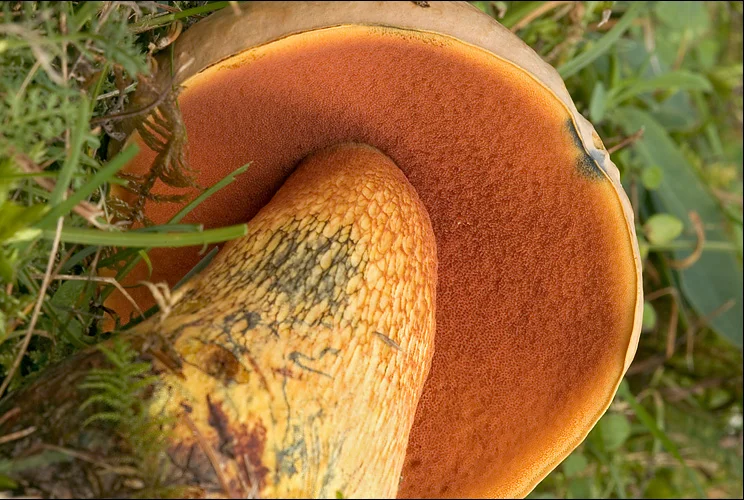 amadej trnkoczy / CC BY-SA 3.0