About this fungus
Magpie Inkcap is a fungus in the Psathyrellaceae family. Its habitat and field characteristics are summarised below.
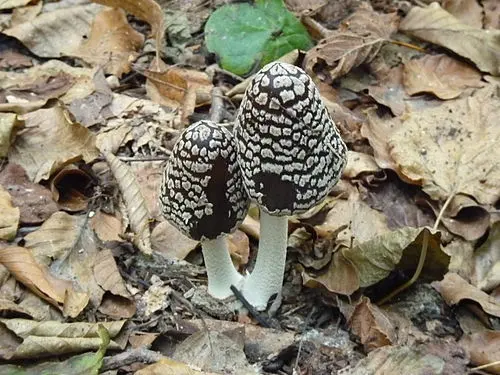
A tall and unmistakably patterned inkcap, with large white or grey veil patches scattered over a dark brown to black cap. Young caps are egg-shaped, later becoming narrowly bell-shaped on a long white stem.
What to check
Look for separate pale patches sitting on a dark cap rather than a uniformly shaggy surface. The crowded gills start white, become reddish or grey, then turn black and dissolve from the edge into an inky fluid. The white stem is hollow and finely woolly or fibrous, especially near its slightly swollen base, without a persistent ring or a sac-like volva.
Variation
A very young fruit body may still be almost completely covered by its pale universal veil. As the cap expands, the veil breaks into contrasting patches and the dark background becomes obvious. In old specimens the margin curls, blackens and dissolves, so the cap may become incomplete.
Lookalikes
Shaggy Inkcap, Coprinus comatus, has a much shaggier white cap with brownish scales and lacks the Magpie Inkcap's black background with separate pale patches. Coprinopsis variegata is a close North American comparison with buff veil patches on a browner cap and may require attention to geography and microscopic details.
Habitat and range
A saprotroph on soil and buried woody material in deciduous woodland, especially beech woodland and sometimes oak, usually among deep leaf litter.
Food safety
Poisonous.
Photographs
 Oliver Snowden / CC BY-SA 3.0