

About this fungus
Mild Milkcap is a fungus in the Russulaceae family. Its habitat and field characteristics are summarised below.
A small, slender European milkcap of broad-leaved woodland, especially beech woods. Its dry reddish-brown to dark cinnamon cap often develops a shallow central depression with a small raised point.
What to check
Check several features together: white latex that remains white after a gill is broken, crowded gills that begin white and become pinkish-buff, a dry unzoned cap with a paler margin, and growth with beech. A cream spore print with a slight salmon-pink tinge provides another useful check.
Variation
Caps range from reddish-brown and rusty brown to dark cinnamon, usually with a paler buff margin. Older caps may fade and become more depressed. The gills change from white to pinkish-buff, while wet caps can appear smoother and darker than dry ones.
Lookalikes
Beech Milkcap, Lactarius blennius, is usually greyer and has a greasier cap. Birch Milkcap, Lactarius tabidus, is often associated with birch and its white latex slowly dries yellow on white tissue. Lactarius camphoratus develops a strong aromatic odour, especially when dry. Orange Milkcap, Lactarius aurantiacus, can share the same warm colours. Small brown milkcaps can overlap closely, so host, latex behaviour, cap texture, odour and sometimes microscopy all matter.
Habitat and range
An ectomycorrhizal European species found mainly with beech, with records under birch and occasionally deciduous oak. It is common in Britain, Ireland and mainland Europe. Similar brownish-orange milkcaps in North America were historically given this name, but current accounts do not treat true Lactarius subdulcis as North American.
Food safety
Edible.
Use this profile to learn what to examine and compare, not as proof that a mushroom is safe to eat. Check the whole specimen and every important lookalike before reaching an identification.
Photographs
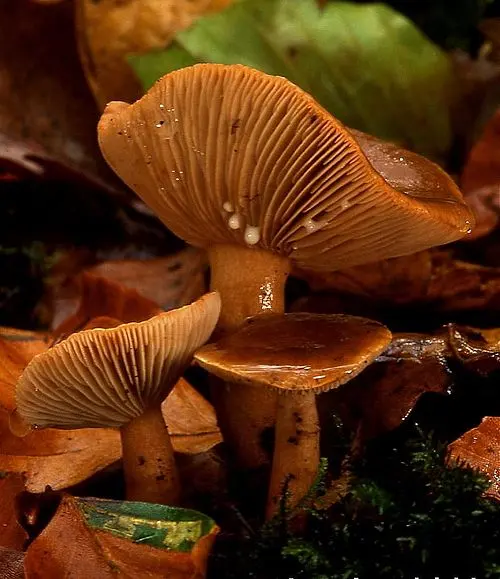 Zonda Grattus / CC BY 3.0
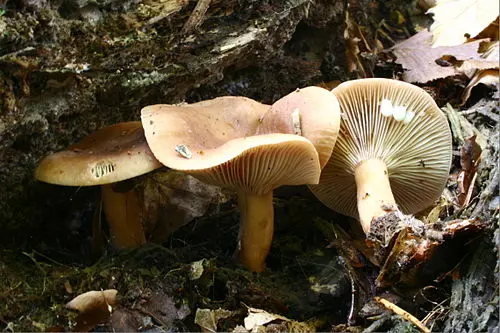 Strobilomyces / CC BY-SA 3.0
Species to compare
Similar mushrooms to compare against: