
About this fungus
Milk-white Brittlegill is a fungus in the Russulaceae family. Its habitat and field characteristics are summarised below.
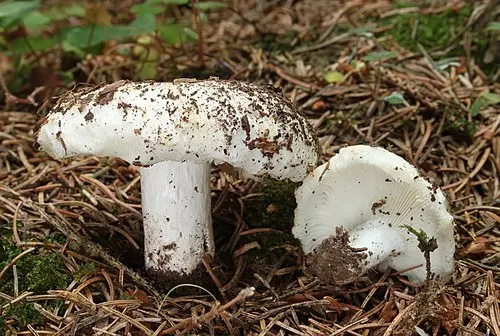
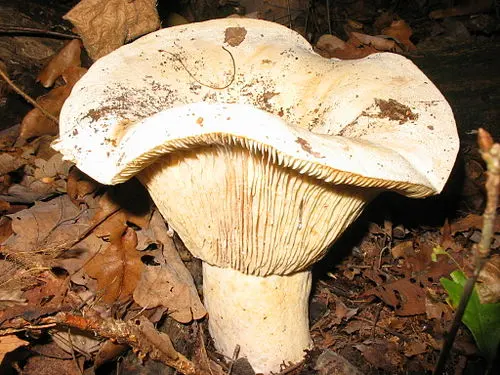
A large, heavy white brittlegill with a deeply depressed or funnel-shaped cap, an inrolled margin and a short stout stem. It often emerges partly buried, leaving soil and leaf fragments stuck to the cap.
What to check
Look for brittle white flesh, narrow pale gills running down the stem, no ring or volva, and no milky liquid from damaged gills. The cap often becomes cream or brown-stained with age. These checks establish the general group, but reliable separation from Russula chloroides and other white members may require spores and microscopic structures.
Variation
Young mushrooms can be nearly pure white, while older caps become cream, buff or patchily brown and often look grubby from attached soil. The faint smell is variable and may be described as unpleasant or fish-like, but it can be indistinct.
Lookalikes
Russula chloroides and several other white Russula species are extremely close. White Lactarius and Lactifluus species have similarly depressed caps but release milk when their gills are damaged. Absence of milk separates the genera, not the exact Russula species. Microscopy or DNA may be needed within the delica complex.
Habitat and range
Ectomycorrhizal on woodland soil with both broadleaved and coniferous trees. The traditional name has been applied broadly across regions, while molecular evidence shows a much richer complex of white species than older field guides recognised. It is not presented as a food mushroom in the app.
Food safety
Inedible.
Photographs
 Hg6996 / Public Domain