

About this fungus
Milky Conecap is a fungus in the Bolbitiaceae family. Its habitat and field characteristics are summarised below.
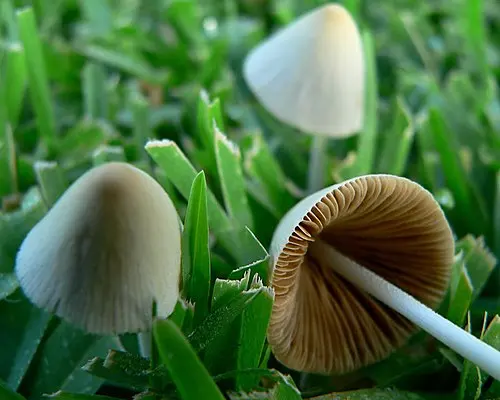
A tiny, exceptionally fragile grassland mushroom with a sharply conical milk-white or cream cap on a very slender pale stem. A fresh group can appear after rain and then wilt within a day in warm or sunny weather, which explains its reputation as a morning mushroom.
What to check
Look for a smooth but finely lined or radially wrinkled cap, usually only one to three centimetres wide. The thin cap flesh often splits at the edge. Gills are close and begin pale ochre, becoming cinnamon to rust-brown as the spores mature. They meet the stem narrowly or appear almost free. The white to cream stem is finely dusty or downy, especially near the top, and may broaden into a small rounded bulb at the base. There is no ring and no volva. Odour is not distinctive.
Variation
Fresh caps are milk-white to cream and sharply conical, then may become bell-shaped and pale beige before collapsing. Drying can darken the cap and exaggerate its radial lines. The gills change much more strongly than the cap, progressing from pale ochre to rusty cinnamon-brown as spores accumulate. Its brief appearance depends on temperature, sun and moisture, so not every fruit body disappears by the same time of day.
Lookalikes
Common Conecap is usually more ochre, tan or cinnamon-brown and is not as strikingly pale, although exact separation within Conocybe can require microscopy. Yellow Fieldcap begins brighter yellow and has a sticky young cap. The deadly Funeral Bell and the related Pholiotina rugosa usually grow from wood or woody debris and have a ring, unlike this ringless grassland species, but small brown-spored mushrooms should never be separated by colour alone. A complete stem base, substrate and mature gills are all important.
Habitat and range
Saprobic in lawns, parks, gardens, playing fields, pastures, meadows and other short grass, with occasional records from leaf litter, sawdust and woodchip mulch. It often fruits after rain from late spring into autumn, with the exact season varying by climate. The name is used across Europe and North America and records also extend into Asia and North Africa, but research suggests that some very similar regional forms may eventually prove distinct.
Food safety
Inedible.
Photographs
 Jason Hollinger / CC BY 2.0