

About this fungus
Mosaic Puffball is a fungus in the Agaricaceae family. Its habitat and field characteristics are summarised below.
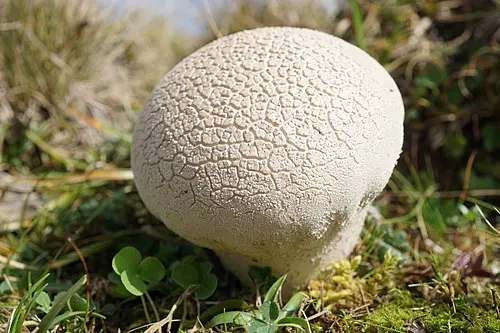
A large rounded grassland puffball whose white outer wall breaks into flat polygonal plates, producing a distinctive mosaic pattern.
What to check
Confirm that the fruit body has no cap, gills or separate stem and that the lower portion forms a broad sterile base. For a young specimen, a complete lengthwise section must be uniformly firm and pure white. Any developing cap, gills, coloured centre or marbling rules it out as a usable young puffball.
Variation
Young fruit bodies are white to pale grey with clear polygonal plates. They turn grey-brown, the plates fall away and the upper wall breaks open to expose olive-brown powdery spores. Old sterile bases can persist as cup-like remains.
Lookalikes
Immature Amanita species can be enclosed in a universal veil and may resemble a puffball from outside, but a section reveals the developing mushroom structure. Earthballs have a thick tough skin and a dark purple-brown to black interior rather than uniform white flesh. Other large puffballs differ in surface texture and the form of the sterile base.
Habitat and range
Saprotrophic on soil in permanent pasture, grazed hillsides, dunes and other short, relatively unimproved grassland. It is widespread in Europe and recorded across other temperate regions.
Food safety
Edible.
Use this profile to learn what to examine and compare, not as proof that a mushroom is safe to eat. Check the whole specimen and every important lookalike before reaching an identification.
Photographs
 xulescu_g / CC BY-SA 2.0