

About this fungus
Ochre Brittlegill is a fungus in the Russulaceae family. Its habitat and field characteristics are summarised below.
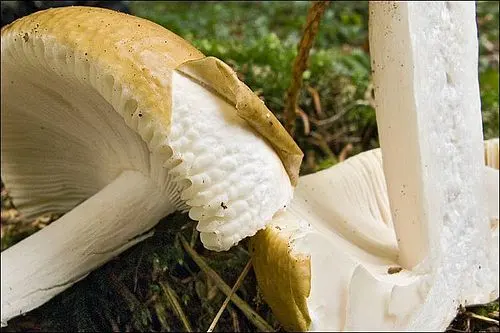
A common woodland brittlegill with a dull ochre-yellow cap, creamy-white gills and a stout white stem. Its flesh and gills have the clean, chalk-like brittleness typical of Russula.
What to check
Look for an ochre-yellow cap that becomes broadly depressed, a margin that develops grooves with age, and a cuticle that often peels well back from the edge. The narrow gills are adnexed to adnate, pale at first and deeper cream later. The stem has no ring or volva and often greys slightly with age. A pale cream spore print supports the identification.
Variation
Caps range from pale yellow to dull ochre and occasionally have a greenish cast. Gills deepen from white-cream to cream, and old stems may grey or show yellow-brown marks. Reported flavour ranges from mild to peppery, so it is not a dependable field separator.
Lookalikes
Yellow Swamp Brittlegill, Russula claroflava, is associated with birch on wet or boggy ground and has a yellower print. Other yellow Russula overlap strongly in colour, and reliable species identification may require microscopic characters and regional keys. Cap colour alone is not enough.
Habitat and range
Ectomycorrhizal in broad-leaved and conifer woodland, often abundant on well-drained soil and especially frequent in pine forest in Europe. It is widely reported across the northern hemisphere, although regional Russula identification remains difficult.
Food safety
Edible.
Use this profile to learn what to examine and compare, not as proof that a mushroom is safe to eat. Check the whole specimen and every important lookalike before reaching an identification.
Photographs
 Amadej Trnkoczy / CC BY-SA 3.0