
About this fungus
Old Man of the Woods is a fungus in the Boletaceae family. Its habitat and field characteristics are summarised below.
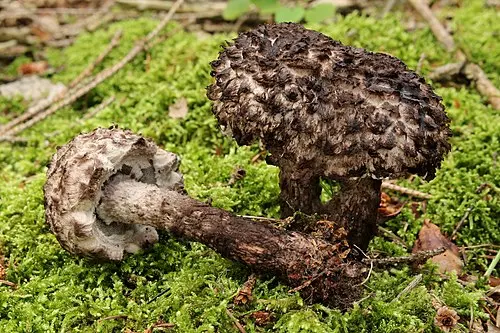
A striking dark bolete with a grey to nearly black cap broken into large upright woolly scales, giving the fruitbody a pine-cone-like appearance.
What to check
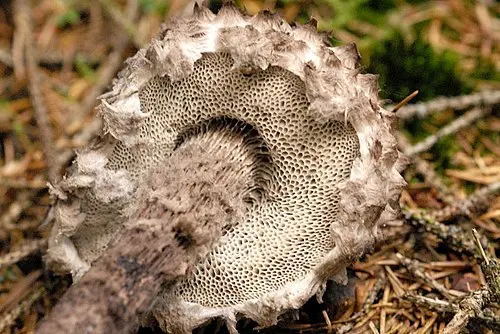
Confirm large angular pores rather than gills. The pores begin pale grey and darken strongly when bruised. Cut flesh passes through pink or wine-red before becoming grey-black. A partial veil on young mushrooms may leave a woolly ring zone on the stem.
Variation
Young fruitbodies have more pale background showing between soft scales. Caps, pores and stems darken with age, and old specimens can become almost black.
Lookalikes
This species is highly distinctive in Europe, but other Strobilomyces species occur in Asia and the Americas. Their cap scales and spore ornamentation may require regional keys or microscopy for reliable separation.
Habitat and range
Mycorrhizal on woodland soil, most often with broadleaf trees such as oak and beech in Europe, but also reported with conifers. It is scarce in parts of its range.
Food safety
Edible.
Use this profile to learn what to examine and compare, not as proof that a mushroom is safe to eat. Check the whole specimen and every important lookalike before reaching an identification.
Photographs
 James Lindsey / CC BY-SA 3.0