

About this fungus
Olive Wax Cap is a fungus in the Hygrophoraceae family. Its habitat and field characteristics are summarised below.
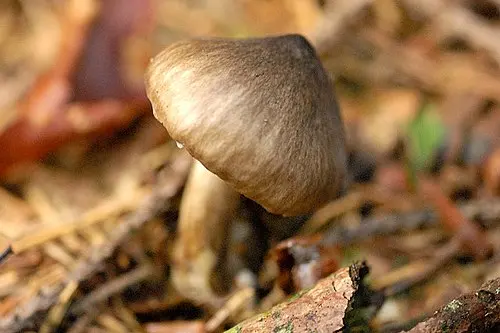
A slimy olive-brown woodwax of conifer woods, with thick white gills and a pale stem marked by dark, ragged bands below a veil zone.
What to check
Look for an olive to grey-brown viscid cap, thick widely spaced white gills, and two veil layers on young mushrooms. The outer slimy veil leaves dark bands on the lower stem, while the inner veil may leave a fragile ring or ring zone. There is no volva.
Variation
The cap begins rounded or slightly conical, then flattens while often retaining a darker central bump. Rain increases the slime, and the stem bands can become clearer as the veil breaks.
Lookalikes
This name has historically covered a complex of similar conifer-associated species. Molecular studies separate European H. olivaceoalbus in a narrow sense from several North American relatives, including H. canadensis. Location, host and microscopic features may be needed for a precise name.
Habitat and range
Mycorrhizal with conifers on woodland soil, often among moss. Published host associations and the exact species represented differ across Europe and North America.
Food safety
Edible.
Use this profile to learn what to examine and compare, not as proof that a mushroom is safe to eat. Check the whole specimen and every important lookalike before reaching an identification.
Photographs
 James Lindsey / CC BY-SA 3.0