
About this fungus
Ornate-stalked Bolete is a fungus in the Boletaceae family. Its habitat and field characteristics are summarised below.
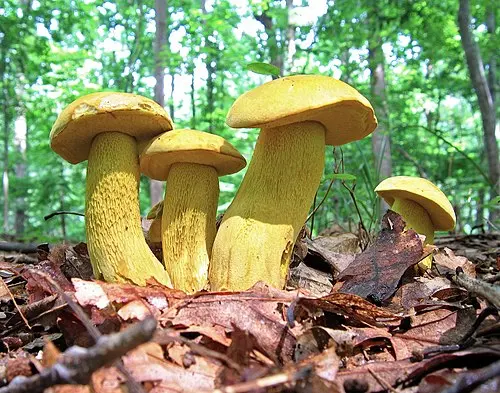
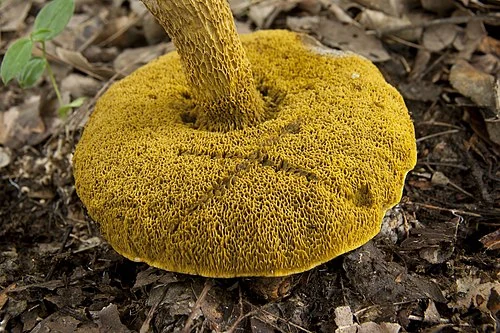
A sturdy yellow to brown bolete with a striking raised yellow network running down most of the stem. The yellow pore surface and lack of blue staining are useful supporting features.
What to check
Confirm pores rather than gills, a dry cap, and coarse raised netting over most of the yellow stem. The pores begin bright yellow and become duller or olive-yellow. Cut flesh should remain yellow or change only slightly. There is no ring or volva.
Variation
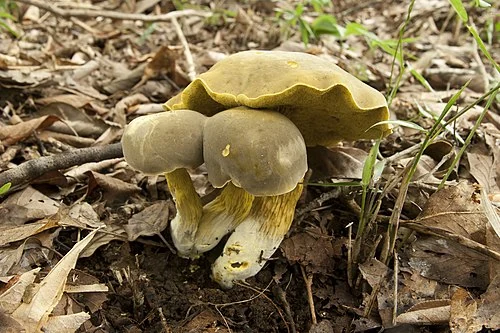
Caps range from yellow through yellow-brown to medium brown, sometimes with greyish tones. The stem network can be less distinct near the base or on weathered specimens, so several features should agree.
Lookalikes
Retiboletus griseus is generally greyer and has a stem that is pale above and darker below. Several similar Retiboletus occur in eastern North America, particularly in the south, and may require microscopic or DNA evidence. East Asian mushrooms formerly given this name are now treated as other species.
Habitat and range
Ectomycorrhizal with hardwoods, especially oaks, in eastern North America and Central America. Summer and autumn are the main fruiting periods. Reports from East Asia should not be assumed to represent the same species.
Food safety
Edible.
Use this profile to learn what to examine and compare, not as proof that a mushroom is safe to eat. Check the whole specimen and every important lookalike before reaching an identification.
Photographs
 Σ64 / CC BY 3.0
 Σ64 / CC BY 3.0