
About this fungus
Ovoid Psilocybe is a fungus in the Hymenogastraceae family. Its habitat and field characteristics are summarised below.
A small wood-loving mushroom first described from Pennsylvania. Its moist cap is orange-brown to yellow-brown, but it can dry to cream or almost white. It usually has a whitish stem, a fleeting white ring and flesh that turns blue after damage. Groups can be tightly clustered among woody debris. Ovoid Psilocybe is a useful plain-English name, while the scientific name refers to the ovoid cells on the gill faces and edges that help confirm it under a microscope.
What to check
Look for attached to slightly notched gills that mature from pale brown to dark brownish-violet, a dark violet spore print, a thin white ring that may soon disappear and blue staining where the cap or stem is handled or broken. The stem is whitish, hollow and often more finely scaly below the ring, with white mycelium at the base. None of these field signs proves the exact species. Reliable separation from other blue-staining, wood-loving Psilocybe may require the thick-walled, roughly diamond-shaped spores and the characteristic ovoid cystidia under a microscope, or a DNA sequence.
Variation
This species is strongly hygrophanous, meaning that its cap changes colour as it loses water. Fresh, wet caps can be dark orange-brown or yellow-brown and slightly sticky, while drying caps become much paler, sometimes nearly white. The cap begins convex to slightly raised at the centre and may broaden with age. Gills darken as spores mature, the ring can vanish, and blue staining varies in strength and may become clearer after a short delay. A single cluster can therefore appear surprisingly mixed in colour and age.
Lookalikes
Galerina marginata is the most important dangerous comparison because it also fruits on wood, has a fading brown cap and may retain a ring. It has a rusty-brown spore print and yellowish gills that turn rusty rather than dark violet-brown, and its flesh does not normally stain blue. Galerina marginata contains amatoxins and can be fatal. A missing blue reaction is useful warning evidence but not a safety test, since staining can be weak and mixed clusters can contain more than one species. Other wood-loving Psilocybe can share blue staining and dark violet spores, so exact identification may still depend on microscopic characters or DNA.
Habitat and range
Saprotrophic on buried wood, wood fragments and other woody debris, including mulch and flood-deposited material in deciduous settings. The species was described from Pennsylvania, and its best-established records are in eastern North America, where documented collections include spring and early-summer fruiting. Reports outside that core range should be judged against local species and confirmed carefully rather than assuming that every similar woodchip mushroom has the same name.
Food safety
Psychoactive.
Photographs
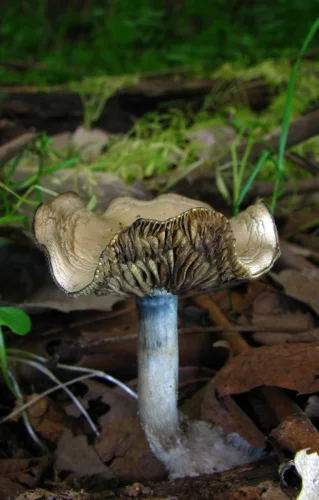 Dan Molter (shroomydan) / CC BY-SA 3.0