

About this fungus
Pallid Bolete is a fungus in the Boletaceae family. Its habitat and field characteristics are summarised below.
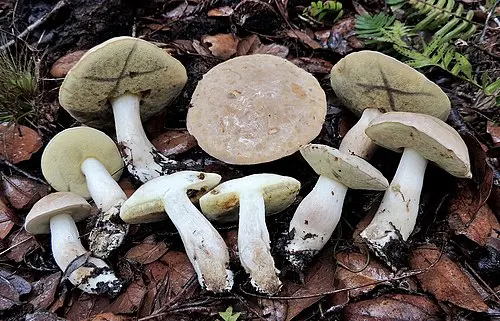
A pale eastern North American bolete with a cream to grey-buff dry cap, yellowing pores and a smooth pale stem that may darken brown-red near the base.
What to check
Confirm pores rather than gills, a very pale cap, yellow to olive-yellow pores, a smooth non-netted stem and an olive-brown spore print. Blue-grey bruising of pores or flesh can be weak, slow, patchy or absent, so it is supporting evidence only.
Variation
Young caps may be almost white and later become buff or pale brown. The pores turn from off-white to yellow or olive-yellow. Flesh can remain unchanged or develop blue, pinkish or reddish tones slowly and unevenly.
Lookalikes
Tylopilus felleus develops pink pores and a dark raised network on the stem, with a pink-brown spore print. Other pale eastern boletes can require microscopy, and rapid dark blue-black staining points away from Imleria pallida.
Habitat and range
Mycorrhizal on soil with oaks and other hardwoods in eastern North America, east of the Rocky Mountains. It should not be assumed to represent pale European boletes with similar common names.
Food safety
Edible.
Use this profile to learn what to examine and compare, not as proof that a mushroom is safe to eat. Check the whole specimen and every important lookalike before reaching an identification.
Photographs
 Jason Bolin / CC BY-SA 3.0