
About this fungus
Panthercap is a fungus in the Amanitaceae family. Its habitat and field characteristics are summarised below.
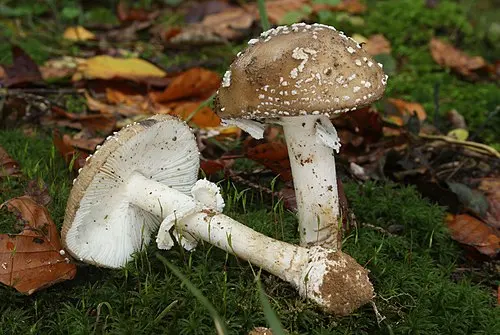
A sturdy Eurasian woodland Amanita with a shiny ochre-brown to dark brown cap, normally scattered with small pure-white warts. White gills, a white hanging ring and a sharply defined, ridged volval collar around the bulbous stem base complete the classic panther-like appearance.
What to check
Excavate the whole stem base rather than snapping it off. The bulb normally has a distinct gutter or collar at its upper edge, often with one or more additional white woolly rings or a spiral just above it. Check for crowded free white gills, a white hanging ring, a finely lined mature cap margin and white flesh that does not develop the wine-red bruising of a Blusher. The upper surface of the ring is usually smoother than the strongly grooved ring of the Blusher or Grey Spotted Amanita. Use the combination of features, because none is completely reliable by itself.
Variation
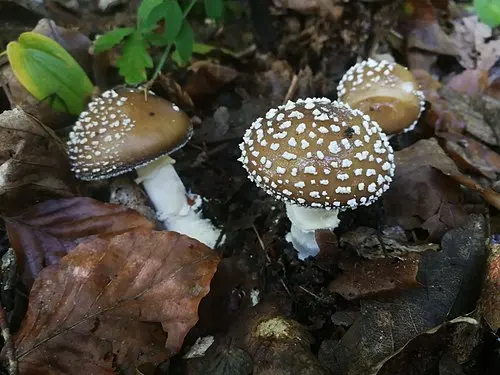
The cap can range from pale ochre or grey-brown to deep brown. White warts may be dense and regular on a fresh young cap, sparse on another specimen, or largely washed away by rain. The cap begins hemispherical, becomes convex and usually flattens, occasionally with a shallow central depression. Rings can become thin or damaged with age, and uncommon ringless forms have been reported. The flesh remains white rather than blushing red when handled.
Lookalikes
The European Blusher develops pink to wine-red marks in damaged flesh and insect tunnels; its veil fragments are greyer, its ring is normally grooved above and its basal volva breaks into less sharply defined fragments. Grey Spotted Amanita also has greyer veil material, a grooved ring and no clear volval gutter. Royal Fly Agaric tends to be larger and darker, with cream to yellowish rather than pure-white veil fragments. In North America and other regions, several similar panther-like Amanitas replace the Eurasian species, so an old field guide may apply the name Amanita pantherina too broadly. Location is part of the identification.
Habitat and range
Ectomycorrhizal on soil in deciduous and mixed woodland, parkland and wooded margins. In Europe it is most often associated with beech, oak and birch, with less frequent records under pine, larch and other conifers; rockrose can also act as a partner in open calcareous grassland. It usually fruits from late summer into autumn, later in southern climates. Modern sources treat similar North American mushrooms as separate regional species rather than assuming they are Amanita pantherina.
Food safety
Poisonous and psychoactive.
Photographs
 Tomasz Sobczak / CC BY-SA 4.0