
About this fungus
Parrot Waxcap is a fungus in the Hygrophoraceae family. Its habitat and field characteristics are summarised below.
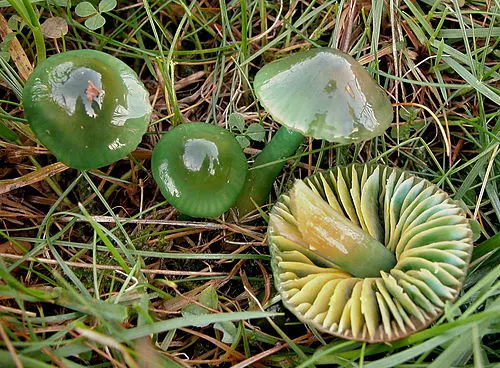
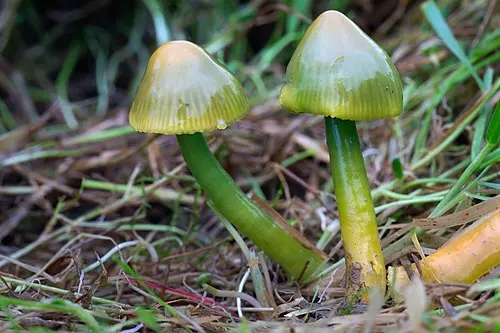
A small and unusually glossy waxcap whose fresh cap and stem often look as if they have been coated in clear glue. Young mushrooms usually show vivid green, while older ones can fade through yellow-green to yellow and become much less obvious in the grass.
What to check
Look for a very slimy cap and stem, with green somewhere on a fresh mushroom and usually still visible near the top of the stem as it ages. The cap begins rounded and may have a small central bump before flattening. The gills are broad, waxy and narrowly attached to the stem. There is no ring or volva and the spore print is white.
Variation
Colour varies far more than the name suggests. Green and yellow are most common, but orange, brick-red, pinkish and purple forms are recorded. Rain and age can reduce the green, yet a trace usually remains near the top of the stem in the familiar European form. Mushrooms with no green at any stage need particular care because several close relatives were once included under the same name.
Lookalikes
Golden Waxcap is yellow but normally lacks green and has a drier stem. Glutinous Waxcap is also very slimy but is yellow, orange or red rather than green. Purple or butterscotch specimens can resemble Gliophorus reginae, G. europerplexus and other members of the wider Parrot Waxcap complex. Some collections, especially outside Europe, cannot be named confidently from appearance alone.
Habitat and range
In Europe it is most strongly associated with long-established, low-nutrient grassland, including pasture, lawns, parks, churchyards, dunes and alpine turf. Similar mushrooms are often found in woodland in North America and other regions, where the name may cover several genetic species. Its underground relationship with plants, mosses and soil is still not fully understood.
Food safety
Inedible.
Photographs
 Stu's Images / CC BY-SA 4.0
Species to compare
Similar mushrooms to compare against: