
About this fungus
Pavement Mushroom is a fungus in the Agaricaceae family. Its habitat and field characteristics are summarised below.
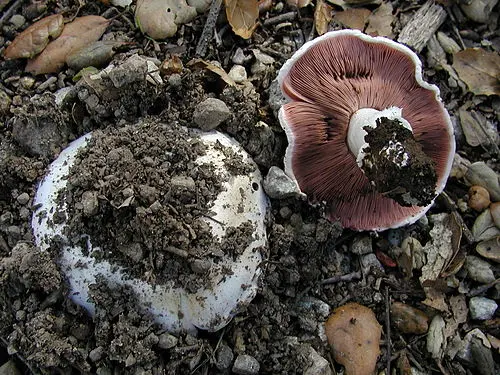
A stocky, tough white Agaricus that often emerges partly buried in compacted soil, beside paving or even through cracks in hard surfaces. Caps are frequently dirty, distorted or cracked by the pressure of the ground rather than appearing clean and evenly rounded.
What to check
Confirm free, crowded gills that begin pink and mature through brown to dark chocolate brown, together with a tough squat stem and no volva. The veil forms a tight sheathing ring low on the stem and often produces two bands, although the double appearance is not equally clear on every specimen. The cap and flesh normally show little or no yellowing or reddening, and the odour is not distinctive. These features must be checked together.
Lookalikes
Agaricus bernardii can be similarly robust but usually reddens more readily and develops a salty or briny odour. Agaricus campestris is generally taller and has a simpler ring. Poisonous members of the Agaricus xanthodermus group often yellow strongly at the stem base and have an unpleasant phenolic or inky odour, but reactions can be weak or variable. A complete Agaricus identification is still necessary.
Habitat and range
Saprotrophic in dry, hard-packed or disturbed soil, especially beside roads, curbs and paths, in parks and gardens, in ditches and between paving. It can displace asphalt or emerge through cracks, but the earlier claim that winter road salt makes it more frequent was not supported by the checked sources. The species occurs across much of the Northern Hemisphere, with season varying by climate.
Food safety
Choice edible.
Use this profile to learn what to examine and compare, not as proof that a mushroom is safe to eat. Check the whole specimen and every important lookalike before reaching an identification.
Photographs
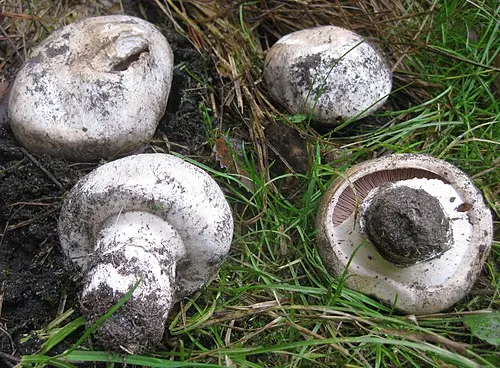 Wilhelm Zimmerling PAR / CC BY-SA 4.0